Next week at the World Cup, a
paralyzed volunteer from the Association for Assistance to Disabled
Children will walk onto the field and open the tournament with a
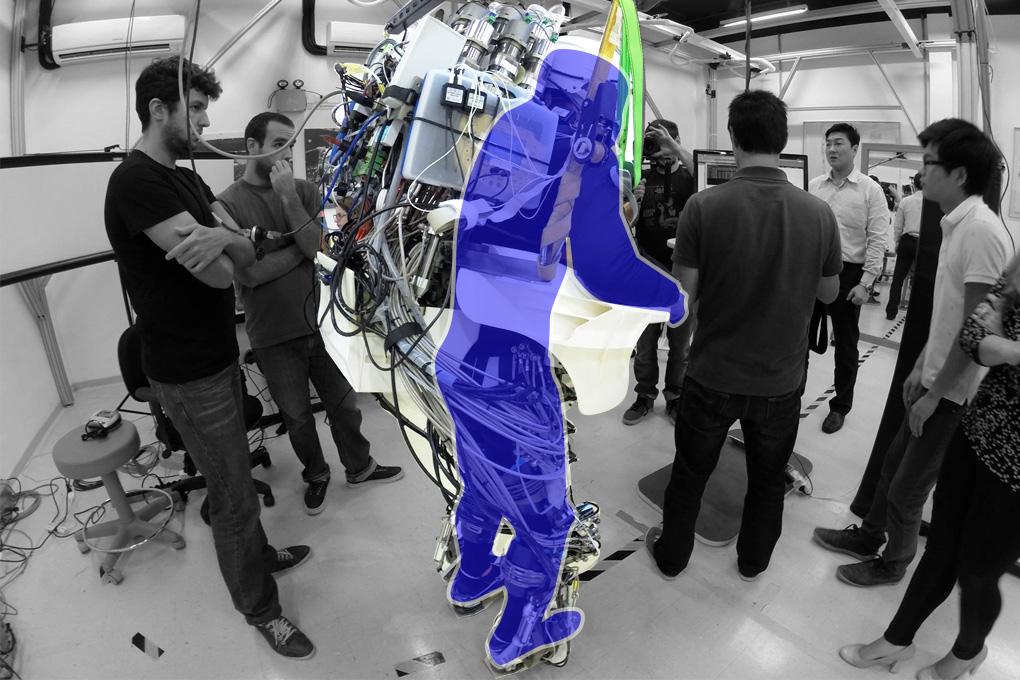
ceremonial kick. This modern miracle is made possible by a robotic
exoskeleton that will move the user's limbs, taking commands directly
from his or her thoughts.
This demonstration is the debut of the Walk Again Project,
a consortium of more than 150 scientists and engineers from around the
globe who have come together to show off recent advances in the field of
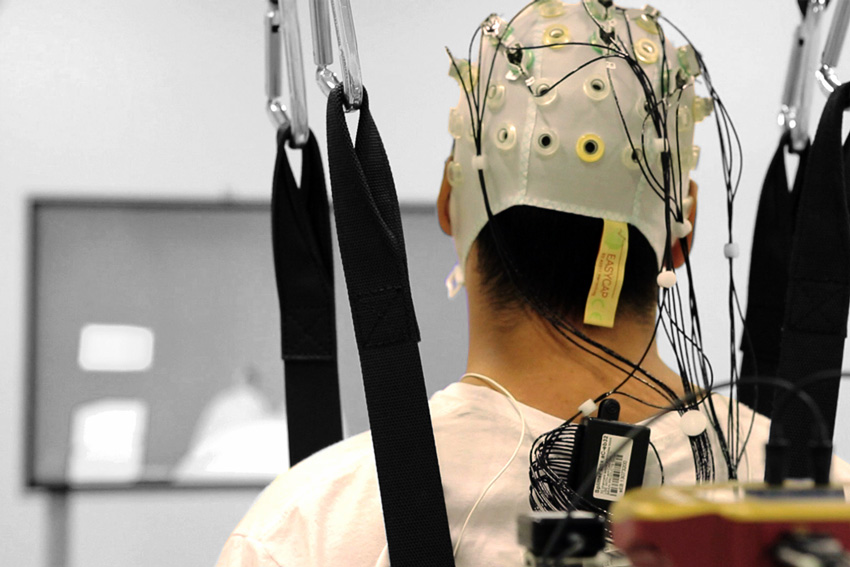
brain machine interfaces, or BMI. The paralyzed person inside will be
wearing an electroencephalographic (EEG) headset that records brainwave
activity. A backpack computer will translate those electrical signals
into commands the exoskeleton can understand. As the robotic frame
moves, it also sends its own signals back to the body, restoring not
just the ability to walk, but the sensation as well.
Just how well the wearer will walk and kick are uncertain. The project has been criticized by other neuroscientists as an exploitative spectacle that uses the disabled to promote research which may not be the best path
for restoring health to paralyzed patients. And just weeks before the
project is set to debut on television to hundreds of millions of fans,
it still hasn’t been tested outdoors and awaits some final pieces and
construction. It's not even clear which of the eight people from the
study will be the one inside the suit.
The point of the project is not
to show finished research, however, or sell a particular technology.
The Walk Again Project is meant primarily to inspire. It's a
demonstration that we’re on the threshold of achieving science fiction:
technologies that will allow humans to truly step into the cyborg era.
It’s only taken a little over two centuries to get there.
The past
Scientists have been studying
the way electricity interacts with our biology since 1780, when Luigi
Galvani made the legs of a dead frog dance by zapping them with a spark,
but the modern history behind the technology that allows our brains to
talk directly to machines goes back to the 1950s and John Lilly. He
implanted several hundred electrodes into different parts of a monkey’s
brain and used these implants to apply shocks, causing different body
parts to move. A decade later in 1963, professor Jose Delgado of Yale
tested this theory again like a true Spaniard, stepping into the ring to
face a charging bull, which he stopped in its tracks with a zap to the brain.
In 1969, professor Eberhard Fetz was able to isolate and record the
firing of a single neuron onto a microelectrode he had implanted into
the brain of a monkey. Fetz learned that primates could actually tune
their brain activity to better interact with the implanted machine. He
rewarded them with banana pellets every time they triggered the
microelectrode, and the primates quickly improved in their ability to
activate this specific section of their brain. This was a critical
observation, demonstrating brain’s unique plasticity, its ability to
create fresh pathways to fit a new language.
Today, BMI research has
advanced to not only record the neurons firing in primates’ brains, but
to understand what actions the firing of those neurons represent. "I
spend my life chasing the storms that emanate from the hundreds of
billions of cells that inhabit our brains," explained Miguel Nicolelis, PhD, one of the founders of Center for Neuroengineering
at Duke University and the driving force behind the Walk Again Project.
"What we want to do is listen to these brain symphonies and try to
extract them from the messages they carry."
Nicolelis and his colleagues at
Duke were able to record brain activity and match it to actions. From
there they could translate that brain activity into instructions a
computer could understand. Beginning in the year 2000, Nicolelis and
his colleagues at Duke made a series of breakthroughs. In the most well
known, they implanted a monkey with an array of microelectrodes that
could record the firing of clusters of neurons in different parts of the
brain. The monkey stood on a treadmill and began to walk. On the other
side of the planet, a robot in Japan received the signal emanating from
the primate’s brain and began to walk.
Primates
in the Duke lab learned to control robotic arms using only their
thoughts. And like in the early experiments done by Fetz, the primates
showed a striking ability to improve the control of these new limbs.
"The brain is a remarkable instrument," says professor Craig Henriquez,
who helped to found the Duke lab. "It has the ability to rewire itself,
to create new connections. That’s what gives the BMI paradigm its power.
You are not limited just by what you can physically engineer, because
the brain evolves to better suit the interface."
The present
After his success with
primates, Nicolelis was eager to apply the advances in BMI to people.
But there were some big challenges in the transition from lab animals to
human patients, namely that many people weren’t willing to undergo
invasive brain surgery for the purposes of clinical research. "There is
an open question of whether you need to have implants to get really fine
grained control," says Henriquez. The Walk Again Project hopes to
answer that question, at least partially. While it is based on research
in animals that required surgery, it will be using only external EEG
headsets to gather brain activity.
The fact that these patients
were paralyzed presented another challenge. Unlike the lab monkeys, who
could move their own arms and observe how the robot arm moved in
response, these participants can’t move their legs, or for many, really
remember the subconscious thought process that takes place when you want
to travel by putting one foot in front of the other. The first step was
building up the pathways in the brain that would send mental commands
to the BMI to restore locomotion.
To train the patients in this
new way of thinking about movement, researchers turned to virtual
reality. Each subject was given an EEG headset and an Oculus Rift.
Inside the head-mounted display, the subjects saw a virtual avatar of
themselves from the waist down. When they thought about walking, the
avatar legs walked, and this helped the brain to build new connections
geared towards controlling the exoskeleton. "We also simulate the
stadium, and the roar of the crowd," says Regis Kopper, who runs Duke’s
VR lab. "To help them prepare for the stress of the big day."
Once
the VR training had established a baseline for sending commands to the
legs, there was a second hurdle. Much of walking happens at the level of
reflex, and without the peripheral nervous system that helps people
balance, coordinate, and adjust to the terrain, walking can be a very
challenging task. That’s why even the most advanced robots have trouble navigating stairs
or narrow hallways that would seem simple to humans. If the patients
were going to successfully walk or kick a ball, it wasn’t enough that
they be able to move the exoskeleton’s legs — they had to feel them as
well.
The breakthrough was a special
shirt with vibrating pads on its forearm. As the robot walked, the
contact of its heel and toe on the ground made corresponding sensations
occur along parts of the right and left arms. "The brain essentially
remapped one part of the body onto another," says Henriquez. "This
restored what we call proprioception, the spacial awareness humans need
for walking."
In recent weeks all eight of
the test subjects have successfully walked using the exoskeleton, with
one completing an astonishing 132 steps. The plan is to have the
volunteer who works best with the exoskeleton perform the opening kick.
But the success of the very public demonstration is still up in the air.
The suit hasn’t been completely finished and it has yet to be tested in
an outdoor environment. The group won't confirm who exactly will be
wearing the suit. Nicolelis, for his part, isn’t worried. Asked when he
thought the entire apparatus would be ready, he replied: "Thirty minutes
before."
The future
The Walk Again project may be
the most high-profile example of BMI, but there have been a string of
breakthrough applications in recent years. A patient at the University of Pittsburgh
achieved unprecedented levels of fine motor control with a robotic arm
controlled by brain activity. The Rehabilitation Institute of Chicago
introduced the world’s first mind controlled prosthetic leg. For now the use of advanced BMI technologies is largely confined to academic and medical research, but some projects, like DARPA’s Deka arm,
have received FDA approval and are beginning to move into the real
world. As it improves in capability and comes down in cost, BMI may
open the door to a world of human enhancement that would see people
merging with machines, not to restore lost capabilities, but to augment
their own abilities with cyborg power-ups.
"From the standpoint of
defense, we have a lot of good reasons to do it," says Alan Rudolph, a
former DARPA scientist and Walk Again Project member. Rudolph, for
example, worked on the Big Dog,
and says BMI may allow human pilots to control mechanical units with
their minds, giving them the ability to navigate uncertain or dynamic
terrain in a way that has so far been impossible while keeping soldiers
out of harms way. Our thoughts might control a robot on the surface of
Mars or a microsurgical bot navigating the inside of the human body.
There is a subculture of DIY biohackers and grinders
who are eager to begin adopting cyborg technology and who are willing,
at least in theory, to amputate functional limbs if it’s possible to
replace them with stronger, more functional, mechanical ones. "I know
what the limits of the human body are like," says Tim Sarver, a member
of the Pittsburgh biohacker collective Grindhouse Wetwares. "Once you’ve
seen the capabilities of a 5000psi hydraulic system, it’s no
comparison."
For now, this sci-fi vision
all starts with a single kick on the World Cup pitch, but our inevitable
cyborg future is indeed coming. A recent demonstration
at the University of Washington enabled one person’s thoughts to
control the movements of another person’s body — a brain-to-brain
interface — and it holds the key to BMI’s most promising potential
application. "In this futuristic scenario, voluntary electrical brain
waves, the biological alphabet that underlies human thinking, will
maneuver large and small robots, control airships from afar," wrote
Nicolelis. "And perhaps even allow for the sharing of thoughts and
sensations with one individual to another."
There is no point in kidding ourselves, now, about Who Has the Power. – Hunter S. Thompson, jacket copy, Fear and Loathing in Las Vegas
The Internet wasn’t supposed to be so…Machiavellian.
In 1963, Stewart Brand
and his wife set out on a landmark road trip, the goal of which was to
educate and enliven the people they encountered with tools for modern
living. The word “tools” was taken liberally. Brand wrote that “a realm
of intimate, personal power is developing.” Any tool that created or
channeled such power was useful. Tools meant books, maps, professional journals, courses, classes, and more.
In 1968, Brand founded the Whole Earth Catalog (WEC), an underground
magazine of sorts that would scale in a way no road-weary Dodge ever
could. The first issue was 64 pages and cost $5. It opened with the
phrase: “We are as gods and might as well get good at it.”
A year after WEC’s start, on October 29, 1969, the first packet of data was sent from UCLA to SRI International. It was called ARPAnet
at the time, but with it the Internet was born. Brand and others would
come to see the Internet as the essential, defining “tool” of their
generation. Until its final issue in 1994, the WEC’s 32 editions provide
as good a chronicle of the emergence of cyberculture (as it was then
called) as you can find.
Cyberculture. It’s a curious and complicated term in today’s society,
isn’t it? Cyberculture is at once completely outdated and awfully
relevant.
As Fred Turner has argued,
Brand is a key figure in the weaving together of two major cultural
fabrics that have since split — counterculture and cyberculture. Brand
is also immortalized in Tom Wolfe’s The Electric Kool-Aid Acid Test as a member of Ken Kesey’s Merry Pranksters. And Brand famously assisted researcher Doug Engelbart with the “Mother of all Demos,” the outline of a vision for technology prosthetics that improve human life; it would define computing for decades to come.
The Merry Pranksters, still from the movie Magic Trip
Brand attended Phillips Exeter Academy — an elite East Coast high
school, and an institution of traditional power if there ever was one.
He was a parachutist in the U.S. Army. He graduated with a degree in
biology from Stanford, studied design at San Francisco Art Institute and
photography at San Francisco State. He also participated in legal
studies of LSD and its effects with Timothy Leary.
That’s hardly the typical resume of a technologist or an entrepreneur
or an investor. But it should be. The business of making culture has
been for too long now controlled by people who live outside it.
It is my opinion that the Internet of today can and must be
countercultural again, that cyberculture should — needs to be —
countercultural.
That word,countercultural,carries with it
the connotation of liberal idealism and societal marginalia. Yet, the
new countercultures we’re seeing online today are profoundly mainstream,
and drawn along wholly different political lines. The Internet is its
own party. The Internet has its own set of beliefs. Springs have sprung
the world over and this isn’t simply a nerd thing anymore. We all care
passionately about Internet life and Internet liberty and the continual
pursuit of happiness both online and off.
Yet if the Internet is a measure of our culture, our zeitgeist, then
what does it tell us about the spirit of this age? Our zeitgeist
certainly isn’t what’s trending; it’s not another quiz of which TV
character you are; it’s not another listicle. I changed the global power
structure and all I got was this lousy t-shirt. And Facebook. And
Twitter.
What is this generation’s Rolling Stone? What is our Whole Earth
Catalog? It’s an important question because if the Internet is defining
our culture, and our use of it defines our society, then we have a
responsibility to ensure and propel its transformative impact, to
understand the ways cyberculture can and should be the counterculture
driving change rather than just distracting us from it.
There are beacons of hope. I eagerly await Jon Evans’ fantastic column in these pages each weekend for reasons like this.
The Daily Dot, a
publication I co-founded, documents today’s cyberculture through the
lens of online communities — virtual locales in which we arguably
“reside” more deliberately than any geography. You should also be
reading Edge, N+1, and Dangerous Minds. Even Vanity Fair has turned its eye to this theme, successfully I think, with articles like this. Rolling Stone is doing a pretty good job of being Rolling Stone these days, too.
I’m terminally optimistic, and I believe that counter-cyber-culture
is inherently optimistic, as well. Even despite the U.S. government’s
overreaching on privacy and “protecting” us from data about our own
bodies, despite Silicon Valley’s mad rush to cash in on apps rather than
substantial technology, despite most online media’s drastic descent to
the lowest common denominator and even lower standards of journalism, I
remain…optimistic.
We have found a courage in our growing numbers online. People old and
young can be be bold and defining on the Internet, underwritten by the
emotional support of peers everywhere. We’re voting for what we want the
world to be, and how we want it to be. Why do you think Kickstarter
works so well? We fund things that without our help are unlikely to
exist, but ought to nonetheless. Our “likes” and “shares” are ultimately
becoming votes for the kind of future we want to live in, and I’m
optimistic that we will ultimately wield that responsibility with
meaning and thoughtfully.
Tumblr. 4chan. Etsy. YouTube. We have emigrated to these outlying
territories seeking religious freedoms, cultural freedoms, and personal
freedoms alike. We colonized, and are still colonizing, new environs
each day and every week. We claim and reclaim the Internet like so many
tribal boundaries.
We’re winning more often than not, thank goodness. Aaron Swartz heroically beat SOPA and PIPA against all odds. Yahoo won against PRISM. The Internet won against cancer…with pizza. My godmother knows what Tor is.
The virtual reality community rebelled when princely Oculus sold to
Facebook, for the reason that VR is a new superpower and a new
countercultural medium that we’re afraid might have fallen into the
wrong hands (I don’t believe that’s actually the case, but that’s
grounds for another post altogether).
So, yes. A countercultural moment all our own stares us in the face.
Like Brand, I hope we can manage to be politically aware and socially
responsible in a way that technology begs us to be, without giving
ground to the idea that the Internet is anything but ours.
Civil disobedience is a different game when the means of production
and dissemination have been fully democratized. We seek differentiated
high ground from which to defend our values. We build new back channels
to communicate unencumbered. Instead of making catalogues, we make new
categories. We wield technology, perhaps unaware on whose shoulders we
stand, but at the same time free from the anxiety of influence.
We aspire to be more pure in that sense. We want and we give and we need and we will have…pure Internet.
Editor’s note:Josh Jones-Dilworth is a co-founder of the Daily Dot; founder and CEO of Jones-Dilworth, Inc., an early-stage technology marketing consultancy; and co-founder of Totem, a startup changing PR for the better. Follow his blog here.
Featured image by Kundra/Shutterstock; Hunter S. Thompson image by Wikimedia Commons user MDCarchives (own work) under a CC-BY-SA-3.0 license
The internet will have nearly 3 billion users, about 40 percent of the world's population, by the end of 2014, according to a new report from the United Nations International Telecommunications Union. Two-thirds of those users will be in developing countries.
Those numbers refer to people who have used the internet in the last three months, not just those who have access to it.
Internet penetration is
reaching saturation in developed countries, while it's growing rapidly
in developing countries. Three out of four people in Europe will be
using the internet by the end of the year, compared to two out of three
in the Americas and one in three in Asia and the Pacific. In Africa,
nearly one in five people will be online by the end of the year.
Mobile phone subscriptions will
reach almost 7 billion. That growth rate is slowing, suggesting that
the number will plateau soon. Mobile internet subscriptions are still
growing rapidly, however, and are expected to reach 2.3 billion by the
end of 2014.
These numbers make it easy to
imagine a future in which every human on Earth is using the internet.
The number of people online will still be dwarfed by the number of
things, however. Cisco estimates the internet already has 10 billion
connected devices and is expected to hit 50 billion by 2020.
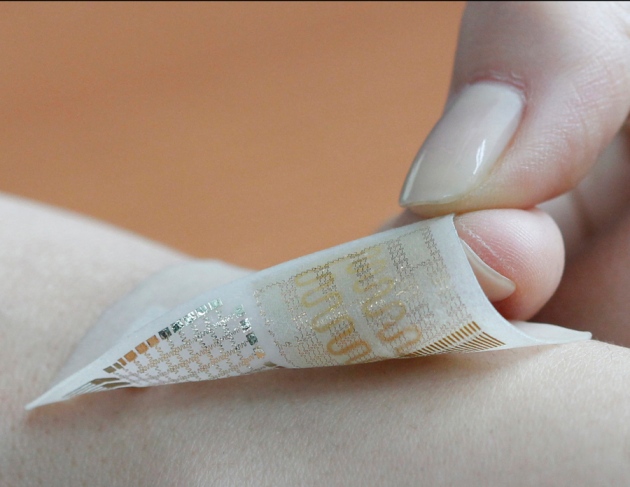
Donghee Son and Jongha Lee - Wearable sensors have until now been unable to store data locally.
Researchers have created a wearable device that is as thin as a
temporary tattoo and can store and transmit data about a person’s
movements, receive diagnostic information and release drugs into skin.
Similar efforts to develop ‘electronic skin’ abound, but the device
is the first that can store information and also deliver medicine —
combining patient treatment and monitoring. Its creators, who report
their findings today in Nature Nanotechnology1, say that the technology could one day aid patients with movement disorders such as Parkinson’s disease or epilepsy.
The
researchers constructed the device by layering a package of stretchable
nanomaterials — sensors that detect temperature and motion, resistive
RAM for data storage, microheaters and drugs — onto a material that
mimics the softness and flexibility of the skin. The result was a sticky
patch containing a device roughly 4 centimetres long, 2 cm wide and 0.3
millimetres thick, says study co-author Nanshu Lu, a mechanical
engineer at the University of Texas in Austin.
“The novelty is really in the integration of the memory device,” says
Stéphanie Lacour, an engineer at the Swiss Federal Institute of
Technology in Lausanne, who was not involved in the work. No other
device can store data locally, she adds.
The trade-off for that memory milestone is that the device works only if
it is connected to a power supply and data transmitter, both of which
need to be made similarly compact and flexible before the prototype can
be used routinely in patients. Although some commercially available
components, such as lithium batteries and radio-frequency identification
tags, can do this work, they are too rigid for the soft-as-skin brand
of electronic device, Lu says.
Even if softer components were available, data transmitted wirelessly
would need to be converted into a readable digital format, and the
signal might need to be amplified. “It’s a pretty complicated system to
integrate onto a piece of tattoo material,” she says. “It’s still pretty
far away.”
Virtual 3D faces can now be produced from DNA code. The application,
developed by Mark Shriver of Pennsylvania State University, produces a
virtual mug shot of potential criminals. Pictured here is a work flow
diagram showing how facial features were processed for the application. (Photo : PLOS ONE)
Models of a criminal's face may so be generated from any trace of DNA
left at the scene of a crime. Computer-generated 3D maps will show
exactly how the suspect would have looked from an angle.
Mark Shriver of Pennsylvania State University and his team developed
the application, which produces a virtual mug shot of potential
criminals.
Shriver and his team took 3D images of almost 600 volunteers, coming
from a wide range of racial and ethnic groups. They superimposed more
than 7,000 digital points of reference on the facial features and
recorded the exact position of each of those markers. These grids were
used to measure how the facial features of a subject differ from the
norm. For instance, they would quantify the distance between the eyes of
a subject, and record how much more narrow or wide they were than
average.
A computer model was created to see how facial features were affected
by sex, genes and race. Each of the study participants were tested for
76 genetic variants that cause facial mutations. Once corrected for
race and sex, 20 genes with 24 variants appeared to reliably predict
facial shape.
"Results on a set of 20 genes showing significant effects on facial
features provide support for this approach as a novel means to identify
genes affecting normal-range facial features and for approximating the
appearance of a face from genetic markers," the researchers wrote in the article announcing the results.
As part of data collection, the team asked participants to rate faces based on perceived ethnicity, as well as gender.
Digital facial reconstructions from DNA have proven to be notoriously
unreliable. Even seemingly simple information like height can be
difficult to determine through genetic analysis. Other aspects of human
physiology, such as eye color, are easier to predict using genetic
analysis.
"One thing we're certain of [is] there's no single gene that suddenly
makes your nose big or small," Kun Tang, from the Shanghai Institutes
for Biological Sciences in China, said.
In order to further refine the system, Shriver has already started
sampling more people. Adding further diversity to the database should
allow the application to make even more accurate recreations of a
person's face. In the next round of testing, 30,000 different points
will be used instead of 7,000. Merging this development with 3D
printers would make it possible to print out 3D models of a person, just based on a piece of DNA.
Such models - digital or physical - are not likely to be used in
courts anytime soon. A more likely scenario is use as modern day version
of police sketches, assisting police in finding suspects. Only after an
arrest would the DNA of a suspect be compared to that collected at the
scene of a crime.
Creating 3D facial models from genetic evidence was detailed in Nature.
Just about every electronic device that we buy today has WiFi hardware embedded inside. Our game consoles like the PS3, PS4, Xbox One, and portable devices all ship with wireless
connectivity. Strategy Analytics has issued a new report that shows 68%
of all consumer electronics devices sold in the US now include WiFi
capability.
When the report is expanded to look at the entire world, 57% of all
consumer electronics devices have WiFi embedded. There are 4 billion
WiFi enabled devices in use around the world today. Breaking that down,
Strategy Analytics says that is about seven WiFi equipped devices for
every home.
Looking around my house, I have more devices that that with multiple smartphones,
game consoles, tablets, DVRs with WiFi, and more. It’s easy to see how 4
billion WiFi devices can be in use around the world. The research firm
predicts that by 2017 there will be over 7 billion WiFi devices in use
globally.
The most common WiFi equipped devices on the market are mobile phones
and tablets. Those two product categories account for 59% of all WiFi
enabled CE devices shipped in 2013. Mobile PCs is the next biggest
category accounting for 9% of WiFi devices shipped. The massive
difference in percentage between mobile phones and tablets compared to
mobile computers makes sense with the computer market on the decline.
Key growth areas for WiFi moving forward will be in cameras, wireless
audio speakers, smart TVs and DVRs according to Strategy Analytics.
The Kentucky Senate just passed a law
that will let students take computer programming classes to satisfy
their foreign language requirements. Do you think that's a good move?
What this
new law means is, rather than taking three years of Spanish or French or
whatever, kids can choose to learn to code. Sure, whether it's Java or
German, they're both technically languages. But they're also two very
different skills. You could easily argue that it's still very necessary
for students to pick up a few years of a foreign tongue—though, on the
other hand, coding is a skill that's probably a hell of a lot more
practically applicable for today's high school students.
I, for one,
have said countless times that if I could travel through time, I
probably would have taken some computer science classes in college. Too
late now, but not for Kentucky teenagers. So what do you think of this
new law?
Qloudlab is the inventor and patent holder of the world’s first
touchscreen-based biosensor. We are developing a cost-effective
technology that is able to turn your smartphone touchscreen into a
medical device for multiple blood diagnostics testing: no plug-in
required with just a simple disposable. Our innovation is at the
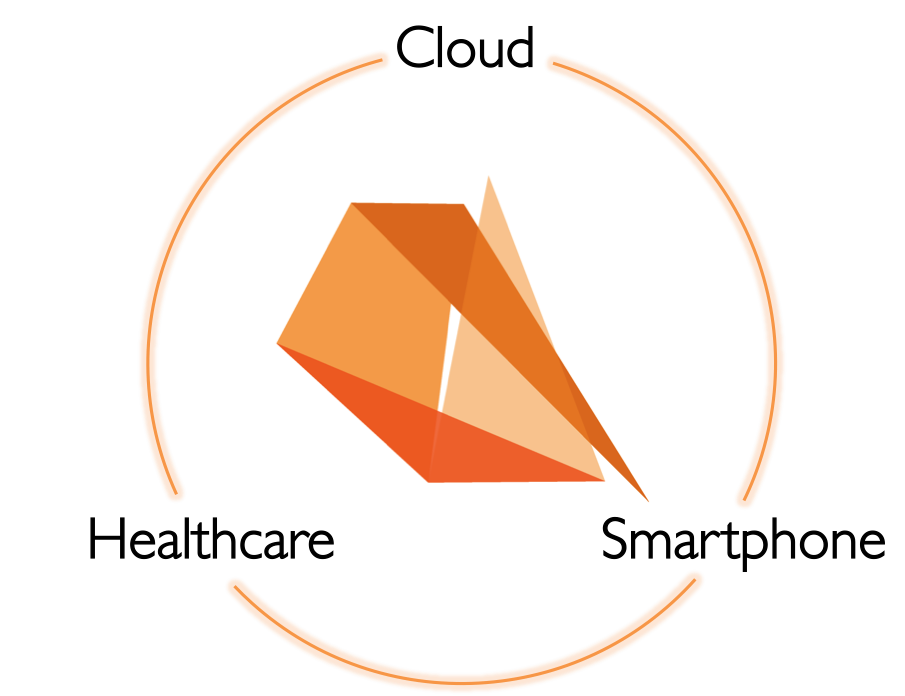
convergence of Smartphones, Healthcare, and Cloud solutions. The
development is supported by EPFL (Pr. Philippe Renaud, Microsystems
Laboratory) and by a major industrial player in cutting-edge touchscreen
solutions for consumer, industrial and automotive products.
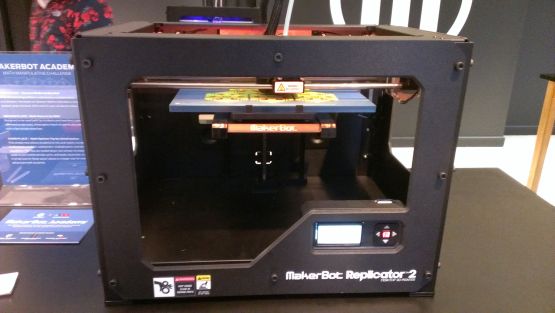
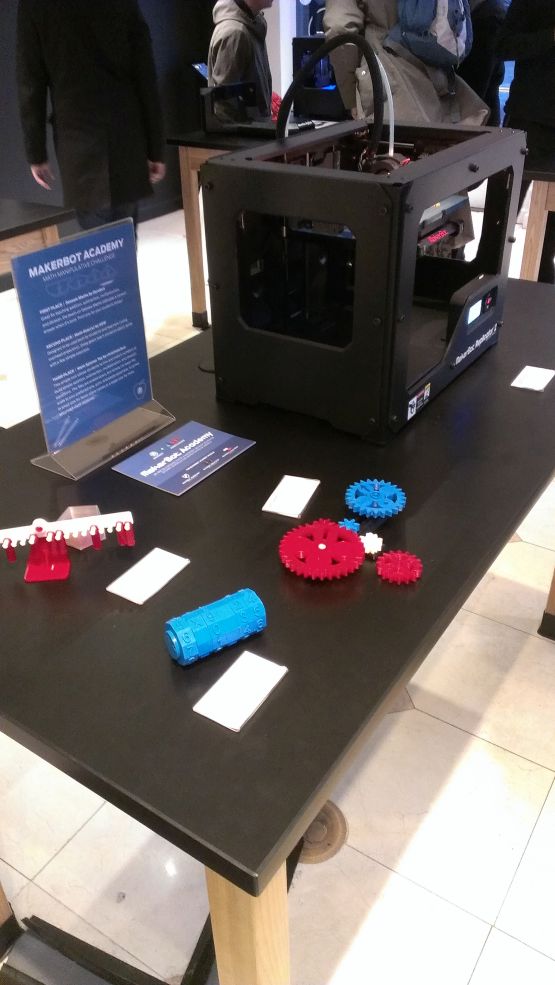
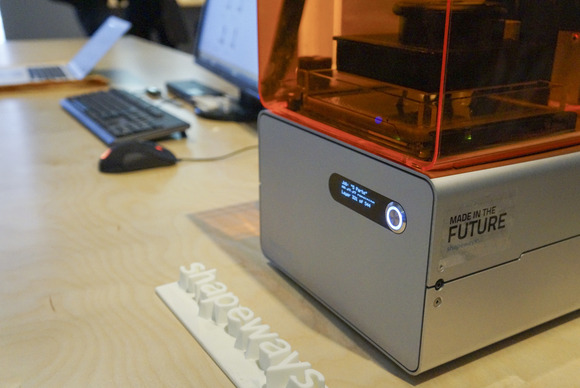
MarkerBot opened this store in Boston on November, 22 2013. There is now 3 such stores in USA (New York, Greenwich and Boston). You can of course buy MakerBot 3D printers, filaments, but there also some 3D printed gifts and some workshops seem to be regularly organized as well.
The shop is located in one of the most famous street for shopping in Boston (144 Newbury Street). Beyond the fact that the MakerBot outlet is contiguous to fashion boutiques (being the only computer hardware shop for miles around), the idea is mainly to democratize the ownership of a 3D printer, trying to morph 3D printer into the fridge of the 21st century.
3D printing may have an image problem. It’s sometimes seen as a
hobbyist pursuit—a fun way to build knickknacks from your living room
desktop—but a growing number of companies are giving serious thought to
the technology to help get new ideas off the ground.
That’s literally off the ground in aircraft maker Boeing’s case.
Thirty thousand feet in the air, some planes made by Boeing are
outfitted with air duct components, wiring covers, and other small,
general parts that have been made via 3D printing, or, as the process is
known in industrial applications, additive manufacturing. The company
also uses additive manufacturing with metal to produce prototype parts
for form, fit and function tests.
Whether it’s the living room or a corporate factory, the underlying
principle of 3D printing—additive manufacturing—is the same. It’s
different from traditional manufacturing techniques such as subtractive
or formative manufacturing, which mainly rely on removing material
through molding, drilling or grinding. Additive manufacturing instead
starts from scratch and binds layers of material sequentially in
extremely thin sheets, into a shape designed with 3D modeling software.
Please, we call it "additive manufacturing"
Boeing has been conducting research and development in the area of
additive manufacturing since 1997, but the company wants to scale up its
processes in the years ahead so it can use the technology to build
larger, structural components that can be widely incorporated into
military and commercial aircraft.
For these larger titanium structures that constitute the backbone of
aircraft, “they generally fall outside of the capacity of additive
manufacturing in its current state because they’re larger than the
equipment that can make them,” said David Dietrich, lead engineer for
additive manufacturing in metals at Boeing.
“That’s our goal through aggressive new machine designs—to scale to larger applications,” he said.
Boeing’s use of 3D printing may seem unconventional because of the
growing attention on the technology’s consumer applications for things
like toys, figurines and sculptures. But it’s not.
In industry, “we don’t like to refer to it as ‘3D printing’ because
the term additive manufacturing has been around longer and is more
accepted,” Dietrich said.
For consumers, some of the more prominent 3D printer makers include
MakerBot, MakieLab and RepRap; industrial-grade makers include 3D
Systems, which also makes lower-cost models, Stratasys, ExOne and EOS.
The cost of a 3D printer varies widely. 3D Systems’ Cube, which is
designed for home users and hobbyists, starts at around $1,300. But
machines built for industrial-grade manufacturing in industries like
aerospace, automotive and medical, such as those made by ExOne, can
fetch prices as high as $1 million.
The average selling price for an industrial-grade 3D printer is about
$75,000, according to market research compiled by Terry Wohlers, an
analyst who studies trends in 3D printing. Most consumer printers go for
between $1,500 and $3,000, he said.
3D printing or additive manufacturing offers several advantages over
traditional subtractive processes. The biggest benefit, some businesses
say, is that the technology allows for speedier, one-off production of
products in-house.
At Boeing, the team handling additive manufacturing in plastics has
cut down its processing time dramatically. While it might take up to a
year to make some small parts using conventional tools, 3D printing can
lessen the processing time to a week, said Michael Hayes, lead engineer
for additive manufacturing in plastics at the company.
The company can also more easily tweak its products using the
technology, he said. “You can fail early,” Hayes said. “You can make the
first part very quickly, make changes, and get to a high-quality part
faster.”
Far beyond the hobbiests
NASA is another organization that is using 3D printers to experiment.
The space agency has been looking at the technology for years, but over
the past six months, NASA’s Jet Propulsion Laboratory has been using
the technology more frequently to test new concepts for parts that may
soon find their way into spacecraft.
Located in Pasadena, California, the lab has a dozen 3D printers
including consumer models made by companies such as MakerBot, Stratasys
and 3D Systems.
Make the virtual world tangible.
Previously, 3D printers were too expensive, but the revolution now is
their affordability, said Tom Soderstrom, chief technology officer at
the lab. JPL uses the printers as a brainstorming tool as part of what
Soderstrom calls their “IT petting zoo.”
So far, the program’s results have been good. This past summer,
mechanical engineers used the printers to create concepts for simple
items like table trays. But an actual stand for a webcam was produced
too, to be used for conference calls. And engineers realized, using the
3D printers, they could incorporate the same swivel mechanism that was
used for the stand into their design for a new spacecraft part for
deploying parachutes.
“That was the ‘aha’ moment,” Soderstrom said, that the printers could
be used to conceive and print parts for actual spacecraft. The swivel
part, which has been designed but not manufactured yet, would provide
wiggle room to the parachute to reduce the torque or rotational impact
when it deploys.
Another advantage of having a 3D printer in-house is that it can give
a company an easier way to fine-tune designs for new products,
Soderstrom said. “It can take you 20 times to get an idea right,” he
said.
Soderstrom hopes that eventually entire spacecraft could be printed
using the technology. The spacecraft would be unmanned, and small,
perhaps a flat panel the size of an art book. “Not all spacecraft need
to look like the Voyager,” Soderstrom said.
For consumer-level 3D printers, the technology is still developing.
Depending on the machine, the printed objects are not always polished,
and the software to make the designs can be buggy and difficult to
learn, Soderstrom said. Software for generating designs for 3D printing
can be supplied by the printer vendor, take the form of computer-aided
design programs such as Autodesk, or come from large engineering
companies like Siemens.
Still, Soderstrom recommends that CIOs make the investment in 3D
printing and purchase or otherwise obtain several machines on loan. They
don’t have to be the most expensive models, he said, but companies
should try to identify which business units might see the most benefit
from the machines. Companies should try to find somebody who can act as
the “IT concierge”—a person with knowledge of the technology who can
advise the company how best to use it.
“Producing a high-fidelity part on some of the cheaper 3D printers
can be hard,” Soderstrom said. “This concierge could help with that.”
Certain skills this person may need could include knowing how to work
with multiple different materials within a single object, he said.
Companies don’t have to be as large as Boeing or NASA to get some use
out of 3D printers. The technology is also an option for small-business
owners and entrepreneurs looking to make customized designs for
prototypes and then print them in small-scale runs.
A new take on 3D printing
One company making strategic use of 3D printing is shipping and
logistics giant UPS. The company, which also makes its services
available to smaller customers via storefront operations, has responded
to the growing interest in the technology with a program designed to
help small businesses and startups that may not have the funds to
purchase their own 3D printer.
A poll of small-business owners conducted by UPS showed high interest
in trying out the technology, particularly among those wanting to
create prototypes, artistic renderings or promotional materials. So, in
July the company announced the start of a program that UPS said makes it the first nationwide retailer to test 3D printing services in-store.
Staples claims to be the first retailer to stock 3D printers for
consumers, but UPS says its program makes it the first to offer 3D
printing services like computer-aided design consultations in addition
to the printing itself.
Currently, there are six independently owned UPS store locations
offering Stratasys’ uPrint SE Plus printer, an industrial-grade machine.
A store in San Diego was the first to get it, followed by locations in
Washington, D.C.; Chicago; New York; and outside Dallas. In September,
the printer was installed at a location in Menlo Park, California, just
off Sand Hill Road in Silicon Valley, a street known for its
concentration of venture capital companies backing tech startups.
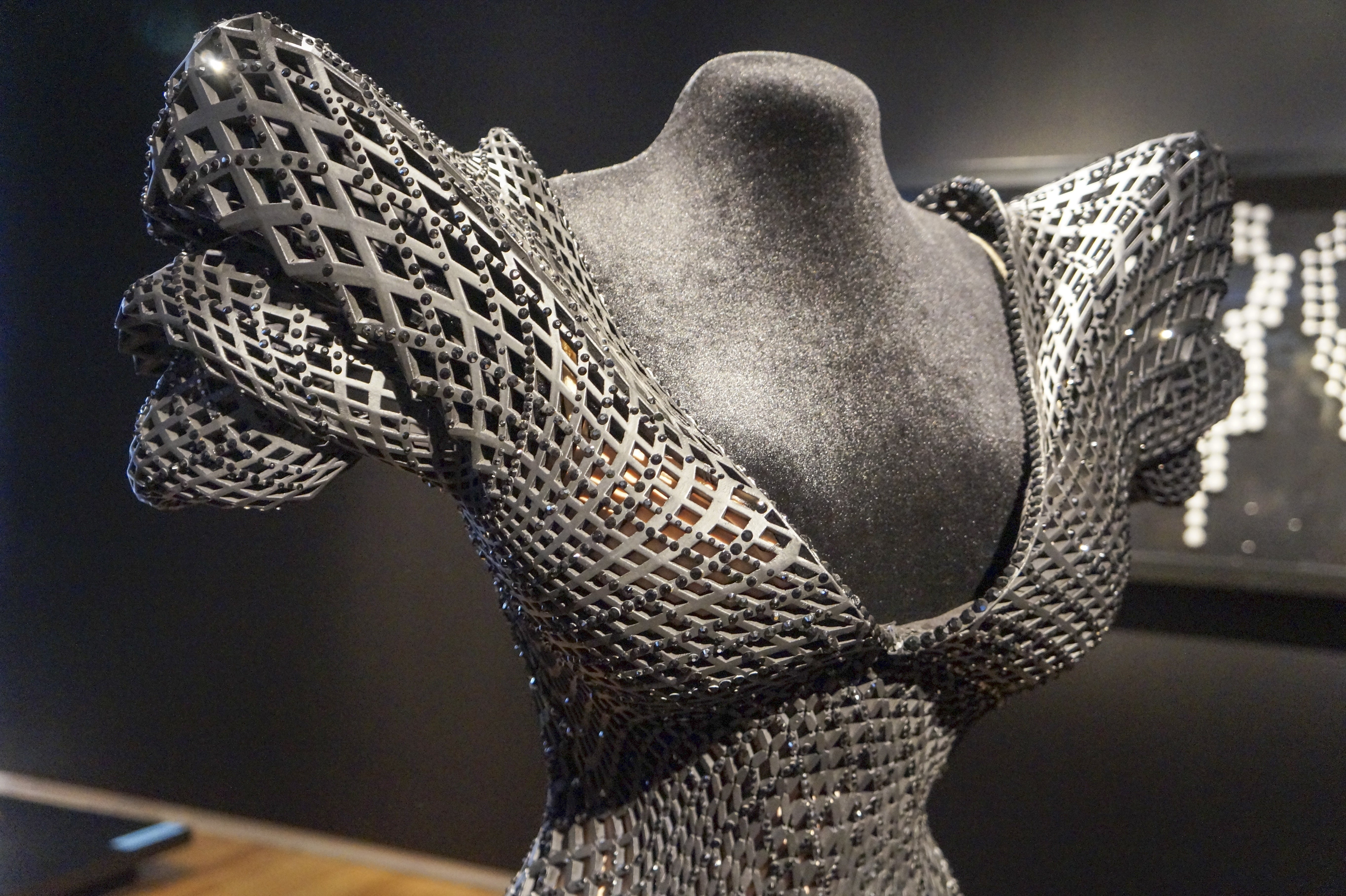
3D printed fashion via Shapeways.
The UPS Store will gather feedback from store owners and customers
over the next 12 months and then will decide whether to add printers in
additional stores if the test is successful.
So far at the San Diego store, costs to the customer have ranged from
$10, for lifelike knuckles printed by a medical device developer, to
$500 for a prototype printed by a prosthetics company. The biggest
factor in determining price is the complexity of the design.
The customer brings in a digital file in the STL format to the store.
The store then checks to make sure the file is print-ready by running
it through a software program. If it is, the customer gets a quote for
the printing and labor costs.
Sometimes the digital file needs to be reworked or created from
scratch. In such cases, the customer can work with a contracted 3D
printing designer to iron out the design. Depending on how this meeting
goes, it can be a several-step process before a file is ready for
printing, said Daniel Remba, the UPS Store’s small-business technology
leader, who leads the company’s 3D printing project.
So far at the San Diego store, there have been several different
types of customers coming in to use the printer, said store owner Burke
Jones. They have ranged from small startups to engineers from larger
companies, government contractors and other people who just have an
interesting idea, he said.
One customer wanted a physical 3D replica of his own head, Jones
said. There was also a scuba diver who printed a light filter for an
underwater lamp and a mountain biker who printed a mount for a camera.
For early stage companies, Jones estimates that the store has printed
roughly a couple dozen product prototypes. In total, the store has done
probably as many as 50 printing jobs for various types of customers, he
said, producing 200 different parts.
In Menlo Park, the store has completed about 10 jobs with the printer, with at least 25 other inquiries pending.
A virtual physical enterprise
There are other online companies that offer 3D printing services. Two sites are Shapeways and Quickparts,
which take files uploaded by the customer and then print the object for
them. But the UPS Store project is different because it’s more
personal, Jones said.
“We get to know the people, and their vision,” he said.
3D Hubs is another company
betting that there are people who are interested in 3D printers but
don’t own one. The site operates like an Airbnb for 3D printers, by
helping people find 3D printers that are owned by other people or
businesses nearby.
3D printing is already a crucial element in some large companies’
manufacturing processes. But for smaller companies, the technology’s
biggest obstacle may be a lack of awareness about when it’s right to use
it, said Pete Brasiliere, an industry analyst with Gartner.
Though the desktop machines may not be as advanced, their popularity
within the “maker” culture could provide that knowledge to the business
world. “The hype around the consumer market has made senior management
aware,” Brasiliere said.