Thursday, September 29. 2011
Wi-Fi networks could detect your breathing and pinpoint your location
Via dvice
-----

Well, this is a little unsettling: it turns out that Wi-Fi signals are slightly affected by people breathing, and with the right tech someone could pinpoint where you are in a room from afar using just Wi-Fi.
This was discovered when University of Utah researcher Neal Patwari was looking for a way to monitor breathing without using uncomfortable equipment. If you can track breathing using just a Wi-Fi signal, it'll make sleep studies easier for both researchers and subjects. And it worked! By laying in a hospital bed surrounded by a bunch of wireless routers, they were able to accurately estimate his breathing rate within 0.4 breaths per minute.
Now that this is known, it's only a matter of time until there's a way to detect people in rooms using Wi-Fi signals. But don't worry! If you're nervous, there's a simple solution: stop breathing.
-----
Wednesday, September 14. 2011
Botnet rentals reveal the darker side of the cloud
Tuesday, September 13. 2011
Mobile Internet Users to Surpass Number of Wireline Users by 2015, Says IDC
Via DailyTech
-----
Between
2010 and 2015, the number of U.S. mobile Internet users will increase by
a compound annual growth rate of 16.6 percent while PCs and other
wireline services first stagnate, then gradually decline
The
International Data Corporation (IDC) released its Worldwide New Media Market Model (NMMM) predictions
yesterday, which forecasts that the number of people who use mobile devices to
access the Internet will significantly increase over the next few years while
wireline internet access will slowly decline.
According to the IDC's Worldwide New Media Market Model, more U.S. internet
users will access the web through mobile devices rather than through PCs or
wireline services by 2015.
Between 2010 and 2015, the number of U.S. mobile internet users will increase
by a compound annual growth rate of 16.6 percent while PCs and other wireline
services first stagnate, then gradually decline.
Globally, the number of internet users will increase from 2 billion in 2010 to
2.7 billion in 2015, as 40 percent of the world's population will have Web
access by that time. Also, global B2C e-commerce spending will increase from
$708 billion in 2010 to $1,285 billion in 2015 at a compound annual growth rate
of 12.7 percent, and worldwide online advertising will increase from $70
billion in 2010 to $138 billion in 2015.
"Forget what we have taken for granted on how consumers use the Internet," said Karsten Weide,
research vice president, Media and Entertainment. "Soon, more users will
access the Web using mobile devices than using PCs, and it's going to make the
Internet a very different place."
These
predictions may seem unsurprising, considering the fact that tech giants like

The spotlight was placed on the decline of wireline services last month
when 45,000 Verizon wireline
employees went on strike because the company had to cut pensions,
make employees pay more for healthcare, etc. in order to cut costs and
compensate for its declining wireline business.
Friday, September 09. 2011
Google -- "How our cloud does more with less"
-----

We’ve worked hard to reduce the amount of energy our services use. In fact, to provide you with Google products for a month—not just search, but Google+, Gmail, YouTube and everything else we have to offer—our servers use less energy per user than a light left on for three hours. And, because we’ve been a carbon-neutral company since 2007, even that small amount of energy is offset completely, so the carbon footprint of your life on Google is zero.
We’ve learned a lot in the process of reducing our environmental impact, so we’ve added a new section called “The Big Picture” to our Google Green site with numbers on our annual energy use and carbon footprint.
We started the process of getting to zero by making sure our operations use as little energy as possible. For the last decade, energy use has been an obsession. We’ve designed and built some of the most efficient servers and data centers in the world—using half the electricity of a typical data center. Our newest facility in Hamina, Finland, opening this weekend, uses a unique seawater cooling system that requires very little electricity.
Whenever possible, we use renewable energy. We have a large solar panel installation at our Mountain View campus, and we’ve purchased the output of two wind farms to power our data centers. For the greenhouse gas emissions we can’t eliminate, we purchase high-quality carbon offsets.
But we’re not stopping there. By investing hundreds of millions of dollars in renewable energy projects and companies, we’re helping to create 1.7 GW of renewable power. That’s the same amount of energy used to power over 350,000 homes, and far more than what our operations consume.
Finally, our products can help people reduce their own carbon footprints. The study (PDF) we released yesterday on Gmail is just one example of how cloud-based services can be much more energy efficient than locally hosted services helping businesses cut their electricity bills.
Thursday, September 08. 2011
Why Google's Offline App Strategy will Benefit Chrome OS
Via OStatic
-----
 Now
that Chromebooks--portable computers based on Google's Chrome OS--are
maturing, it's easier to gauge the prospects for Google's first-ever
operating system. As Jon Buys discussed
here on OStatic, these portables have a number of strong points.
However, there are criticisms appearing about them, too, and some of
them echo ones made here on OStatic before.
Specifically, Chrome OS imposes a very two-fisted, cloud-centric model
for using data and applications, where traditional, local storage of
data and apps is discouraged. Recently, Google has sought to close
this gap with its own apps, allowing users to work with its Gmail,
Calendar and Docs apps offline. Will these moves help boost Chrome OS
and use of Chromebooks? In enterprises, they may do so.
Now
that Chromebooks--portable computers based on Google's Chrome OS--are
maturing, it's easier to gauge the prospects for Google's first-ever
operating system. As Jon Buys discussed
here on OStatic, these portables have a number of strong points.
However, there are criticisms appearing about them, too, and some of
them echo ones made here on OStatic before.
Specifically, Chrome OS imposes a very two-fisted, cloud-centric model
for using data and applications, where traditional, local storage of
data and apps is discouraged. Recently, Google has sought to close
this gap with its own apps, allowing users to work with its Gmail,
Calendar and Docs apps offline. Will these moves help boost Chrome OS
and use of Chromebooks? In enterprises, they may do so.
Google officials have explained the logic behind allowing offline usage of key Google apps in this post, where they write:
"Today’s world doesn’t slow down when you’re offline and it’s a great feeling to be productive from anywhere, on any device, at any time. We’re pushing the boundaries of modern browsers to make this possible, and while we hope that many users will already find today’s offline functionality useful, this is only the beginning. Support for offline document editing and customizing the amount of email to be synchronized will be coming in the future. We also look forward to making offline access more widely available when other browsers support advanced functionality (like background pages)."
While Google had previously
announced its intent to deliver this offline functionality, the need for
it was undoubtedly accelerated by some of the criticisms of the way
Chrome OS forces users to work almost exclusively in the cloud. It's
also not accidental that the offline capabilities are focused on Google
applications that enterprises care about: mail, document-creation apps,
etc.
Guillermo Garron has gone so far as to reverse his previous
criticisms of Chrome OS based on the new offline functionality, as seen in his post here. He writes:
"This is something specially good for Chromebooks. Now they are not just new toys, they can be real productive tools…now Chromebooks are ready for Prime Time at least to do what they were designed for, with no limitations."Researchers at Microsoft have produced data before that shows that most people use a maximum of five software applications on a regular basis. In delivering offline functionality for mail, document creation, and other absolutely key tasks for working people, Google is hedging the cloud-only bet that it made with Chrome OS upon its debut. It's the right move for Google to be making, and is likely to help win over some enterprises that would find working exclusively in the cloud to be too limiting.
Norton cyber crime study offers striking revenue loss statistics
Via MyCE
-----
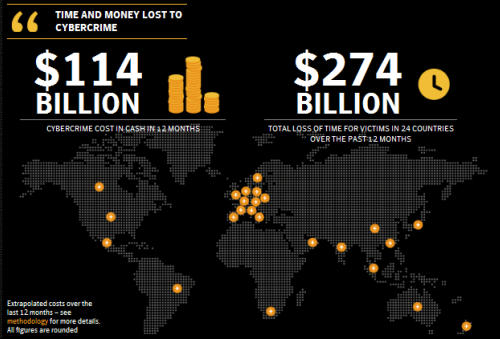
Symantec, the company behind Norton Anti-Virus, has published a startling report which estimates nearly $388 billion is lost each year to cyber crime – $274 billion in sheer wasted time, and the remaining $114 billion either spent to combat it or deposited into the bank accounts of criminals.
Source: Norton
According to the “Norton Cybercrime Report 2011,” viruses and malware are the “preventable yet more prevalent” methods employed by cyber criminals. Conducted earlier this year by StrategyOne, who polled 19,636 adults, kids and teachers in 24 countries, the study revealed over 54 percent of online adults have indeed encountered either threat despite the fact 59 percent incorporate active, up-to-date anti-virus software. Online scams and phishing rounded out the most common methods.
Resolving a cyber crime is also a huge hassle for those affected. Norton’s research found the entire process takes anywhere from four to 16 days depending on where you live; on average, victims spend 10 days.
“These latest cyber crime statistics reflect crime rates in the physical world, where young adults and men are more often victims of crime,” said Adam Palmer, Norton Lead Cyber Security Analyst. “Countries like South Africa and Brazil, where physical crimes against people are among the highest in the world, are clearly emerging as cyber crime capitals, too.”
China topped Norton’s list of countries most affected by cyber crime, boasting an ignominious 85 percent of adults affected. The U.S. wasn’t too far behind at 73 percent.
The fact the Internet is such a huge part of everyday life in many countries means cyber thieves have ample prey. 24 percent of respondents said that they “can’t live without the Internet,” while 41 percent “need the Internet in their everyday life.” Considering that level of dependency, it’s not too shocking that nearly 70 percent of adults reported being the victim of some form of cyber crime.
Joseph LaBrie, an Associate Professor of Psychology at Loyola Marymount University, addressed the mental state of online users and their resistance to educating or protecting themselves.
“Often, because people feel the Internet is too complicated and the threats are unknown or ambiguous, they default to a learned helplessness where they simply accept cyber crime as part of the cost of going online,” said LaBrie. “Also, they cannot visualize online protection like they can offline security systems like a fence or alarm that act as a physical deterrent.”
Norton asserts that each day cyber crime affects over one million people and that 431 million people have been victims of cyber crime in the last year alone. (via Threat Post)
-----
The study
Quicksearch
Popular Entries
- The great Ars Android interface shootout (131758)
- Norton cyber crime study offers striking revenue loss statistics (102938)
- MeCam $49 flying camera concept follows you around, streams video to your phone (100790)
- Norton cyber crime study offers striking revenue loss statistics (59167)
- The PC inside your phone: A guide to the system-on-a-chip (59071)


