Friday, March 30. 2012
Fake ID holders beware: facial recognition service Face.com can now detect your age
Via VB
-----
Facial-recognition platform Face.com could foil the plans of all those under-age kids looking to score some booze. Fake IDs might not fool anyone for much longer, because Face.com claims its new application programming interface (API) can be used to detect a person’s age by scanning a photo.
With its facial recognition system, Face.com has built two Facebook apps that can scan photos and tag them for you. The company also offers an API for developers to use its facial recognition technology in the apps they build.
Its latest update to the API can scan a photo and supposedly determine a person’s minimum age, maximum age, and estimated age. It might not be spot-on accurate, but it could get close enough to determine your age group.
“Instead of trying to define what makes a person young or old, we provide our algorithms with a ton of data and the system can reverse engineer what makes someone young or old,” Face.com chief executive Gil Hirsch told VentureBeat in an interview. ”We use the general structure of a face to determine age. As humans, our features are either heighten or soften depending on the age. Kids have round, soft faces and as we age, we have elongated faces.”
The algorithms also take wrinkles, facial smoothness, and other telling age signs into account to place each scanned face into a general age group. The accuracy, Hirsch told me, is determined by how old a person looks, not necessarily how old they actually are. The API also provides a confidence level on how well it could determine the age, based on image quality and how the person looks in photo, i.e. if they are turned to one side or are making a strange face.
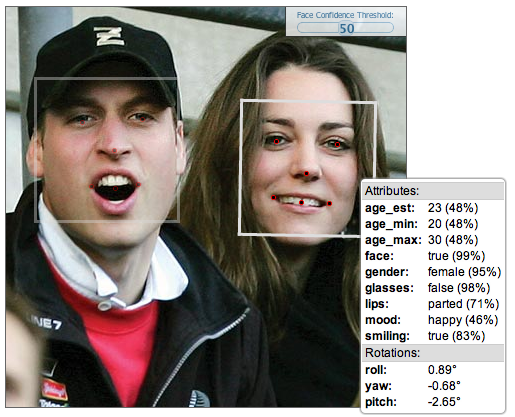
“Adults are much harder to figure out [their age], especially celebrities. On average, humans are much better at detecting ages than machines,” said Hirsch.
The hope is to build the technology into apps that restrict or tailor content based on age. For example the API could be built into a Netflix app, scan a child’s face when they open the app, determine they’re too young to watch The Hangover, and block it. Or — and this is where the tech could get futuristic and creepy — a display with a camera could scan someone’s face when they walk into a store and deliver ads based on their age.
In addition to the age-detection feature, Face.com says it has updated its API with 30 percent better facial recognition accuracy and new recognition algorithms. The updates were announced Thursday and the API is available for any developer to use.
One developer has already used the API to build app called Age Meter, which is available in the Apple App Store. On its iTunes page, the entertainment-purposes-only app shows pictures of Justin Bieber and Barack Obama with approximate ages above their photos.
Other companies in this space include Cognitec, with its FaceVACS software development kit, and Bayometric, which offers FaceIt Face Recognition. Google has also developed facial-recognition technology for Android 4.0 and Apple applied for a facial recognition patent last year.
The technology behind scanning someone’s picture, or even their face, to figure out their age still needs to be developed for complete accuracy. But, the day when bouncers and liquor store cashiers can use an app to scan a fake ID’s holder’s face, determine that they are younger than the legal drinking age, and refuse to sell them wine coolers may not be too far off.
Thursday, March 15. 2012
MIT App Inventor open beta preview debuts
Via Slash Gear
-----
Back in January, we talked a bit about the new MIT App Inventor software aimed at helping people that aren’t developers to build their own apps. MIT promised to have App Inventor available in Q1 of 2012. The first quarter is quickly winding down, and it was looking a bit like MIT might not make its self-imposed deadline.
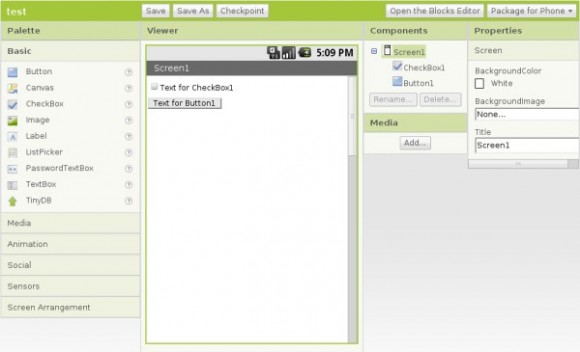
MIT has now announced that it is meeting the goal of making App Inventor available as a public service in Q1. The App Inventor software has been in closed testing the last two months with 5000 users. The App Inventor software is now available in open beta to anyone who has a Google ID to login, such as a Gmail account.
MIT points out that the software is suitable for any use, but users need to be aware that this will be the first time the system is loaded so heavily, which could cause issues. MIT suggests that users make backups of important apps as the service ramps up with more and more users, in case there are issues. MIT also notes that it is still working on fixing remaining glitches and other errors.
We owe a large debt to our testers of the past few months; it’s been their feedback that’s given us the confidence for today’s announcement. And we’re tremendously grateful to the folks who have been running their own system with the MIT JAR files. Their experiences have been an invaluable source of information, and their work has been critical in keeping App Inventor alive while the MIT service was not yet available. We also want to acknowledge the growing group of developers who are starting to explore the App Inventor source code. They are the seeds of an open source community that we hope will take App Inventor beyond anything we could do by ourselves at MIT. And our extreme gratitude and admiration goes to the Google App Inventor team who, even while their project transitions out of Google, have continued to share their expertise and the fruit of their hard work of the past three years.
Monday, March 12. 2012
Mozilla’s Boot 2 Gecko and why it could change the world
Quicksearch
Popular Entries
- The great Ars Android interface shootout (131621)
- Norton cyber crime study offers striking revenue loss statistics (102656)
- MeCam $49 flying camera concept follows you around, streams video to your phone (100649)
- Norton cyber crime study offers striking revenue loss statistics (58885)
- The PC inside your phone: A guide to the system-on-a-chip (58848)


