Tuesday, November 27. 2012
Smart light socket lets you control any ordinary light via Wi-Fi
Via DVICE
-----

Internet-connected devices are clearly the future of controlling everything from your home to your car, but actually getting "the Internet of things" rolling has been slow going. Now a new project looks to brighten those prospects, quite literally, with a smart light socket.
Created by Zach Supalla (who was inspired by his father, who is deaf and uses lights for notifications), the Spark Socket lets you to connect the light sockets in your home to the Internet, allowing them to be controlled via PC, smartphone and tablet (iOS and Android are both supported) through a Wi-Fi connection. What makes this device so compelling is its simplicity. By simply screwing a normal light bulb into the Spark Socket, connected to a standard light fixture, you can quickly begin controlling and programming the lights in your home.
Some of the uses for the Spark Socket include allowing you to have your house lights flash when you receive a text or email, programming lights to turn on with certain alarms, and having lights dim during certain times of the day. A very cool demonstration of how the device works can be tested by simply visiting this live Ustream page and tweeting #hellospark. We tested it and the light flashed on instantly as soon as we tweeted the hashtag.
The device is currently on Kickstarter, inching closer toward its $250,000 goal, and if successful will retail for $60 per unit. You can watch Supalla offer a more detailed description of the product and how it came to be in the video below.
Saturday, November 17. 2012
StayInvisible Analyzes Your Online Privacy and Anonymity
Via Life Hacker
-----
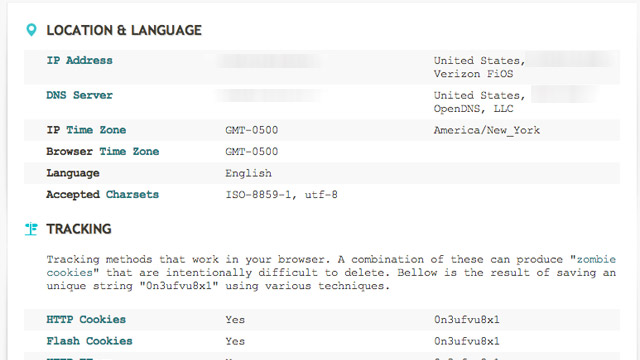
How anonymous are you when browsing online? If you're not sure, head to StayInvisible, where you'll get an immediate online privacy test revealing what identifiable information is being collected in your browser.
The site displays the location (via IP address) and language collected, possible tracking cookies, and other browser features that could create a unique fingerprint of your browser and session.
If you'd prefer your browsing to be private and anonymous, we have lots of guides for that. Although StayInvisible no longer has the list of proxy tools we mentioned previously, the site is also still useful if you want to test your proxy or VPN server's effectiveness. (Could've come in handy too for a certain CIA director and his biographer.)
Thursday, November 01. 2012
Telefonica Digital shows off Thinking Things for connecting stuff to the web
Via Slash Gear
-----
Telefonica Digital has unveiled a new plastic brick device designed to connect just about anything you can think of to the Internet. These plastic bricks are called Thinking Things and are described as a simple solution for connecting almost anything wirelessly to the Internet. Thinking Things is under development right now.
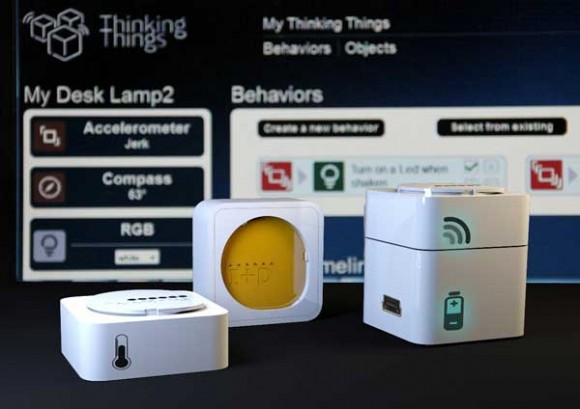
Telefonica I+D invented the Thinking Things concept and believes that the product will significantly boost the development of M2M communications and help to establish an Internet of physical things. Thinking Things can connect all sorts of inanimate objects to the Internet, including thermostats and allows users to monitor various assets or tracking loads.
Thinking Things are comprised of three different elements. The first is a physical module that contains the core communications and logic hardware. The second element is energy to make electronics work via a battery or AC power. The third element is a variety of sensors and actuators to perform the tasks users want.
The Thinking Things device is modular, and the user can connect together multiple bricks to perform the task they need. This is an interesting project that can be used for anything from home automation offering simple control over a lamp to just about anything else you can think of. The item connected to the web using Thinking Things automatically gets its own webpage. That webpage provides online access allowing the user to control the function of the modules and devices attached to the modules. An API allows developers to access all functionality of the Thinking Things from within their software.
Quicksearch
Popular Entries
- The great Ars Android interface shootout (131758)
- Norton cyber crime study offers striking revenue loss statistics (102934)
- MeCam $49 flying camera concept follows you around, streams video to your phone (100787)
- Norton cyber crime study offers striking revenue loss statistics (59163)
- The PC inside your phone: A guide to the system-on-a-chip (59068)
Categories

Show tagged entries
Syndicate This Blog
Calendar

|
November '12 |

|
||||
| Mon | Tue | Wed | Thu | Fri | Sat | Sun |
| 1 | 2 | 3 | 4 | |||
| 5 | 6 | 7 | 8 | 9 | 10 | 11 |
| 12 | 13 | 14 | 15 | 16 | 17 | 18 |
| 19 | 20 | 21 | 22 | 23 | 24 | 25 |
| 26 | 27 | 28 | 29 | 30 | ||