Wednesday, December 05. 2012
Infographic: Where your cloud data really lives
Via TechHive
-----
More and more of our data--our credit card numbers, tweets, photos, personal documents, browsing habits, music, and a hundred other things--is stored "in the cloud." The cloud metaphor evokes images of bits and bytes floating around in the ether somewhere, and we rarely hear tech companies talking about their data centers, where the data really lives.
That's partly because data centers are boring. They're typically huge concrete buildings that contain rows and rows of servers in racks, with a couple of guys who walk around looking thoughfully at little blinking lights, and then making little checkmarks on a clipboard. Another reason you don't hear much about data centers is that all those servers require huge amounts of power to run them and keep them cool—and in some cases this makes them far from green.
At any rate, the image below shows the locations of many of the major data centers that preserve your Amazon, Apple, Facebook, Google, Microsoft, and Twitter data.

Monday, December 03. 2012
A Drawing Machine that Records the Chaos of Pinball
Via This is colossal
-----



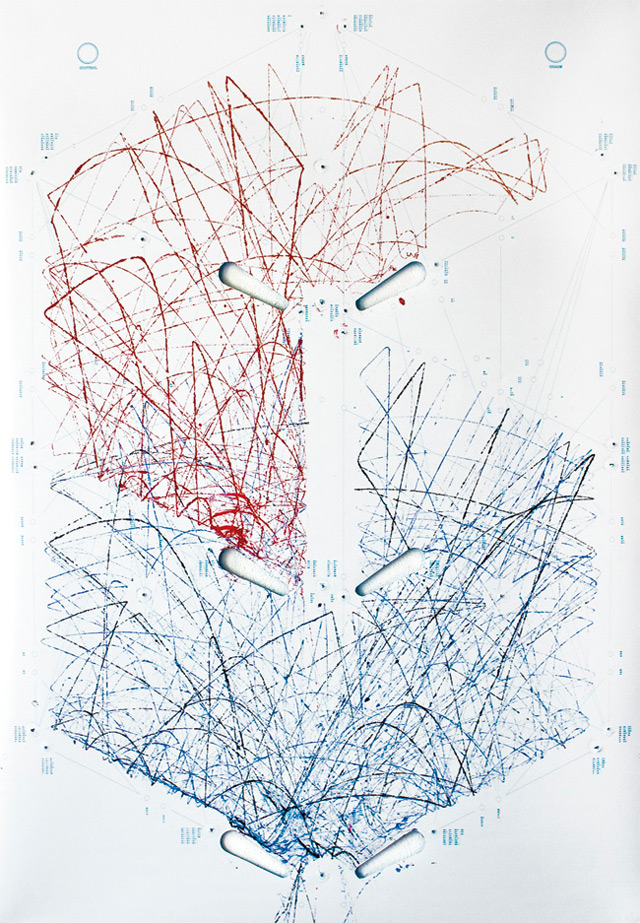
From the pendulum-based drawing machine by Eske Rex to the art of Tim Knowles
who attaches writing implements to trees, I love when the seemingly
random lines of chaos (or maybe just physics) are rendered visible using
ink or pencil. This latest project titled STYN by Netherlands-based graduate student Sam van Doorn
is no exception. Using modified parts from an old pinball machine van
Doorn created a one-of-a-kind drawing device that utilizes standard
flippers to control a ink-covered sphere that moves across a temporary
poster placed on the game surface. He suggets that skill then becomes a
factor, as the better you are at pinball the more complex the drawing
becomes. See much more on his website, here. My drawing would have a single line that goes between the flippers and then have TILT written all over it.
Quicksearch
Popular Entries
- The great Ars Android interface shootout (131693)
- Norton cyber crime study offers striking revenue loss statistics (102778)
- MeCam $49 flying camera concept follows you around, streams video to your phone (100725)
- Norton cyber crime study offers striking revenue loss statistics (59007)
- The PC inside your phone: A guide to the system-on-a-chip (58933)
Categories

Show tagged entries
Syndicate This Blog
Calendar

|
December '12 |

|
||||
| Mon | Tue | Wed | Thu | Fri | Sat | Sun |
| 1 | 2 | |||||
| 3 | 4 | 5 | 6 | 7 | 8 | 9 |
| 10 | 11 | 12 | 13 | 14 | 15 | 16 |
| 17 | 18 | 19 | 20 | 21 | 22 | 23 |
| 24 | 25 | 26 | 27 | 28 | 29 | 30 |
| 31 | ||||||