Friday, August 26. 2011
MicroGen Chips to Power Wireless Sensors Through Environmental Vibrations
Via Daily Tech
-----
MicroGen Systems says its chips differ from other vibrational energy-harvesting devices because they have low manufacturing costs and use nontoxic material instead of PZT, which contains lead.
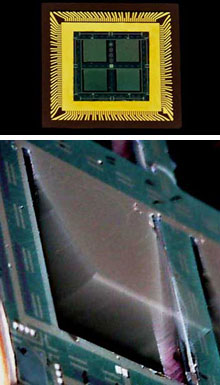
(TOP) Prototype wireless sensor battery with four energy-scavenging chips. (BOTTOM) One chip with a vibrating cantilever (Source: MicroGen Systems )
MicroGen
Systems is in the midst of creating energy-scavenging chips that will convert
environmental vibrations into electricity to power wireless sensors.
The
chip's core consists of an array of small silicon cantilevers that
measure one centimeter squared and are located on a
"postage-stamp-sized" thin film battery. These cantilevers oscillate
when the chip is shook, and at their base is piezoelectric material that produces electrical potential when strained by
vibrations.
The current travels from the piezoelectric array through an electrical device
that converts it to a compatible form for the battery. When jostling the chip
by vibrations of a rotating tire, for example, it can generate 200 microwatts
of power.
Critics such as David Culler, chair of computer science at the University of
California, have said that 200 microwatts may be useful at a small size, but
other harvesting techniques through solar, light, heat, etc. are
more competitive technologies since they can either store the electrical energy
on a battery or use it right away.
But according to Robert Andosca, founder and president of Ithaca, New
York-based MicroGen Systems, his chips differ from other vibrational
energy-harvesting devices because they have low manufacturing costs and use
nontoxic material instead of PZT, which contains lead.
Most piezoelectric materials must be assembled by hand and can be quite large.
But MicroGen's chips can be made inexpensively and small because they are based
on silicon microelectrical mechanical systems. The chips can be made on the
same machines used to make computer chips.
MicroGen Systems hopes to use these energy-harvesting chips to power wireless sensors like those that
monitor tire pressure. The chips could eliminate the need to replace these
batteries.
"It's a pain in the neck to replace those batteries," said Andosca.
MicroGen Systems plans to sell these chips at $1 a piece, depending on the
volume, and hopes to begin selling them in about a year.
Wednesday, August 03. 2011
WIMM Wearable Platform
Via SlashGear
-----
Wearable sub-displays keep coming around, and WIMM Labs is the latest company to try its hand at the segment. Its WIMM Wearable Platform – a 1.4-inch color touchscreen, scaled to be wearable on your wrist, and paired with WiFi, Bluetooth, various sensors and running Android-based “Micro Apps” – obviously stood out of the crowd, having caught the attention of Foxconn and two rounds of financing from the huge manufacturing/ODM company. We caught up with the WIMM Labs team to check out the Wearable Platform and find out if it stood more chance of success than, say, Sony Ericsson’s LiveView.
The basic premise of the Wearable Platform isn’t new. People carry their phones and tablets in pockets and bags, not in their hand, and so when nuggets of information, alerts and updates come in, they need to be taken out in order to check them. A wearable display – strapped to your wrist, hanging on a lanyard from your belt or bag, or otherwise attached to you – means at-a-glance review, allowing you to decide whether you need to fish out your phone or if it can wait until later.
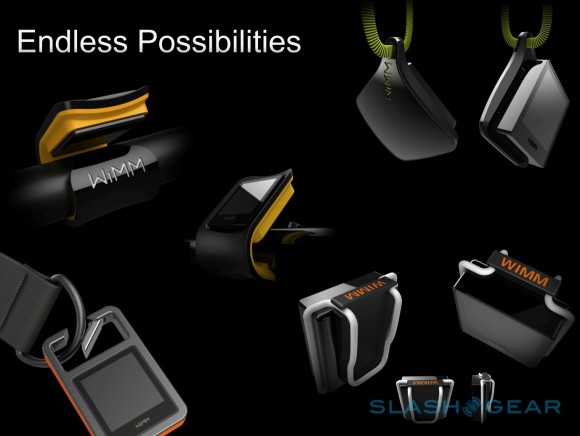
WIMM’s One developer kit hardware is a step ahead of some systems we’ve already seen. The 1.4-inch capacitive touch display operates in dual-modes, either as a regular screen or transflective backlight-free so that it’s still readable (albeit in monochrome) but battery life is extended. This passive display mode works in tandem with a 667MHz Samsung microcontroller, WiFi, Bluetooth, GPS, an accelerometer and a digital compass, all contained in a waterproof casing – made of either plastic or of a new wireless-compatible ceramic – measuring 32 x 36 x 12.5 mm and weighing 22g.
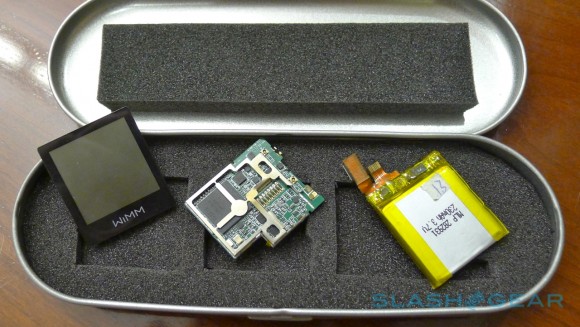
That casing, WIMM says, should be standardized so that each unit – the Wearable Platform will be licensed out to third-party companies – will hopefully be interchangeable with the same mounting pins. That way, if you buy a new model from another firm, it should be able to snap into your existing watch strap. Up to 32GB of memory is supported, and the One can notify you with audio or tactile alerts. Battery life is said to last at least a full day, and it recharges using a magnetic charger (that plugs in via microUSB) or a collapsable desk-stand that adds an integrated battery good for up to four recharge cycles and useful if you’re on the road.
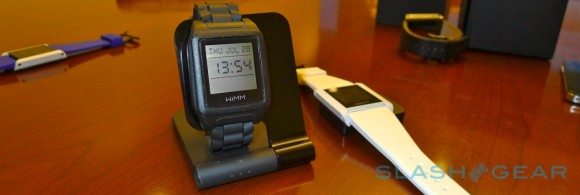
Control is via a series of taps, swipes and physical gestures (the sensors allow the Wearable Platform to react to movement), including a two-finger swipe to pull down the watch face. WIMM will preload a handful of apps – the multifunction clock, a real-time information viewer showing weather, etc, and a cellphone companion which can show incoming caller ID, a preview of new SMS messages, and assist you in finding a lost phone. Pairing can be either via WiFi or Bluetooth, and the micro-display will work with Android, iOS and BlackBerry devices. Apps are selected from a side-scrolling carousel, loaded by flicking them up toward the top of the screen, and closed by flicking them down.
However, the preloaded apps are only to get you interested: the real movement, WIMM expects, is in the Micro App store. The Android-based SDK means there’s few hurdles for existing Android developers to get up to speed, and licensees of the Wearable Platform will be able to roll out their own app stores, based on WIMM’s white label service, picking and choosing which titles they want to include. The company is targeting performance sport and medical applications initially, with potential apps including exercise trackers, heart rate monitors and medication reminder services.
A DIY UAV That Hacks Wi-Fi Networks, Cracks Passwords, and Poses as a Cell Phone Tower
Via POPSCI
By Clay Dillow
-----

Just a Boy and His Cell-Snooping, Password-Cracking, Hacktastic Homemade Spy Drone via Rabbit-Hole
Last year at the Black Hat and Defcon security conferences in Las Vegas, a former Air Force cyber security contractor and a former Air Force engineering systems consultant displayed their 14-pound, six-foot-long unmanned aerial vehicle, WASP (Wireless Aerial Surveillance Platform). Last year it was a work in progress, but next week when they unveil an updated WASP they’ll be showing off a functioning homemade spy drone that can sniff out Wi-Fi networks, autonomously crack passwords, and even eavesdrop on your cell phone calls by posing as a cell tower.
WASP is built from a retired Army target drone, and creators Mike Tassey and Richard Perkins have crammed all kinds of technology aboard, including an HD camera, a small Linux computer packed with a 340-million-word dictionary for brute-forcing passwords as well as other network hacking implements, and eleven different antennae. Oh, and it’s autonomous; it requires human guidance for takeoff and landing, but once airborne WASP can fly a pre-set route, looping around an area looking for poorly defended data.
And on top of that, the duo has taught their WASP a new way to surreptitiously gather intel from the ground: pose as a GSM cell phone tower to trick phones into connecting through WASP rather than their carriers--a trick Tassey and Perkins learned from another security hacker at Defcon last year.
Tassey and Perkins say they built WASP so show just how easy it is, and just how vulnerable you are. “We wanted to bring to light how far the consumer industry has progressed, to the point where public has access to technologies that put companies, and even governments at risk from this new threat vector that they’re not aware of,” Perkins told Forbes.
Consider yourself warned. For details on the WASP design--including pointers on building your own--check out Tassey and Perkins site here.
Monday, August 01. 2011
World's first 'printed' plane snaps together and flies
Via CNET
By Eric Mach
-----
English engineers have produced what is believed to be the world's first printed plane. I'm not talking a nice artsy lithograph of the Wright Bros. first flight. This is a complete, flyable aircraft spit out of a 3D printer.

The SULSA began life in something like an inkjet and wound up in the air. (Credit: University of Southhampton)
The SULSA (Southampton University Laser Sintered Aircraft) is an unmanned air vehicle that emerged, layer by layer, from a nylon laser sintering machine that can fabricate plastic or metal objects. In the case of the SULSA, the wings, access hatches, and the rest of the structure of the plane were all printed.
As if that weren't awesome enough, the entire thing snaps together in minutes, no tools or fasteners required. The electric plane has a wingspan of just under 7 feet and a top speed of 100 mph.
Jim Scanlon, one of the project leads at the University of Southhampton, explains in a statement that the technology allows for products to go from conception to reality much quicker and more cheaply.
"The flexibility of the laser-sintering process allows the design team to revisit historical techniques and ideas that would have been prohibitively expensive using conventional manufacturing," Scanlon says. "One of these ideas involves the use of a Geodetic structure... This form of structure is very stiff and lightweight, but very complex. If it was manufactured conventionally it would require a large number of individually tailored parts that would have to be bonded or fastened at great expense."
So apparently when it comes to 3D printing, the sky is no longer the limit. Let's just make sure someone double-checks the toner levels before we start printing the next international space station.
-----
Personal comments:
Industrial production tools back to people?
Fab@Home project
Quicksearch
Popular Entries
- The great Ars Android interface shootout (131715)
- Norton cyber crime study offers striking revenue loss statistics (102815)
- MeCam $49 flying camera concept follows you around, streams video to your phone (100739)
- Norton cyber crime study offers striking revenue loss statistics (59044)
- The PC inside your phone: A guide to the system-on-a-chip (58949)
Categories

Show tagged entries
Syndicate This Blog
Calendar

|
August '11 |

|
||||
| Mon | Tue | Wed | Thu | Fri | Sat | Sun |
| 1 | 2 | 3 | 4 | 5 | 6 | 7 |
| 8 | 9 | 10 | 11 | 12 | 13 | 14 |
| 15 | 16 | 17 | 18 | 19 | 20 | 21 |
| 22 | 23 | 24 | 25 | 26 | 27 | 28 |
| 29 | 30 | 31 | ||||