Tuesday, January 31. 2012
Build Up Your Phone’s Defenses Against Hackers
Monday, January 30. 2012
What happened to innovative games?
Via #AltDevBlogADay
-----
Indie developer Nimblebit dropped a PR bomb on Zynga yesterday
with it’s letter addressing the similarities between their hit iPhone
game Tiny Tower and Zynga’s upcoming release, Dream Heights. This
galvanized the gaming community, with thousands of people, from prominent bloggers to gamers on Reddit criticizing the company.

However, just after the new year, Atari ordered the removal of Black Powder Media’s Vector Tanks, a game strongly inspired by Atari’s Battlezone. This galvanized the community in a similar way, except this time, gamers were furious that Atari shut down an indie game company that made an extremely similar game.
Unfortunately, the line between inspiration and copying is incredibly blurry at best. The one thing that’s certain is that copying is here to stay. Copying has been present in some form since the dawn of capitalism (if you need proof, just go to the toothpaste isle of your local supermarket). The game industry is no stranger to this trend: game companies have been copying each other for years. Given it’s repeated success, there’s little reason to think that this practice will stop. Indie flash game studio XGEN Studios posted a response to Nimblebit, showing that their hit games were also copied:

Some would even argue that the incredibly successful iOS game Angry Birds was a copy of the popular Armor Games flash game, Crush the Castle, but then Crush the Castle was inspired by others that game before it. Social games even borrow many of their game mechanics from slot machines to increase retention. So what is copying, or more importantly, which parts of it are moral and immoral? Everyone seems to have a different answer, but it’s safe to say that people always copy the most successful ideas. The one thing that those in the Zynga-Nimblebit conversation seems to have overlooked is that everyone copies others in some way.

Of course, while imitation may be the sincerest form of flattery, it doesn’t feel good to be imitated when a competitor comes after your users. In this case, people may question Zynga’s authenticity and make a distinction between inspiration and outright duplication. But at the same time, Zynga’s continued success with the “watch, then replicate” model shows that marketing, analytics, and operations can improve on an existing game concept. Or just give them the firepower to beat out the original game, depending on how you look at it.
Friday, January 20. 2012
Did Google ever have a plan to curb Android fragmentation?
Via ZDNet
-----

Another day, another set of Android fragmentation stories. And while there’s no doubt that there is wide fragmentation within the platform, and there’s not real solution in sight, I’m starting to wonder if Google ever had a plan to prevent the platform for becoming a fragmented mess.
How bad’s the problem? Jon Evans over on TechCrunch tells it like it is:
OS fragmentation, though, is an utter disaster. Ice Cream Sandwich is by all accounts very nice; but what good does that do app developers, when according to Google’s own stats, 30% of all Android devices are still running an OS that is 20 months old?
…
More than two-thirds of iOS users had upgraded to iOS 5 a mere three months after its release. Anyone out there think that Ice Cream Sandwich will crack the 20% mark on Google’s platform pie chart by March?
He then goes on to deliver the killer blow:
OS fragmentation is the single greatest problem Android faces, and it’s only going to get worse. Android’s massive success over the last year mean that there are now tens if not hundreds of millions of users whose handset manufacturers and carriers may or may not allow them to upgrade their OS someday; and the larger that number grows, the more loath app developers will become to turn their back on them. That unwillingness to use new features means Android apps will fall further and further behind their iOS equivalents, unless Google manages – via carrot, stick, or both – to coerce Android carriers and manufacturers to prioritize OS upgrades.
And that’s the core problem with Android. While there’s no doubt that consumers who’ve bought Android devices are being screwed out of updates that they deserve (the take up of Android 4.0 ‘Ice Cream Sandwich’ is pretty poor so far), the biggest risk from fragmentation is that developers will ignore new Android features an instead focus on supporting older but more mainstream feature sets. After all, developers want to hit the masses, not the fringes. Also, the more platforms developers have to support, the more testing work there is.
OK, so Android is fragmented, and it’s a problem that Google doesn’t seem willing to tackle. But the more I look at the Android platform and the associated ecosystem, it makes me wonder if Google ever had any plan (or for that matter intention) to control platform fragmentation.
But could Google have done anything to control fragmentation? Former Microsoftie (and now investor) Charlie Kindel thinks there no hope to curb fragmentation. In fact, he believes that most things will make it worse. I disagree with Kindel on this matter. He also believes that Google’s current strategy amounts to little more that wishing that everyone will upgrade. On this point we are in total agreement.
I disagree with Kindel that that there’s nothing that Google can do to at least try to discourage fragmentation. I believe that one of Google’s strongest cards are Android users themselves. Look at how enthusiastic iPhone and iPad owners are about iOS updates. They’re enthusiastic because Apple tells them why they should be enthusiastic about new updates. Compare this to Google’s approach to Android customers. Google (or anyone else in the chain for that matter) doesn’t seem to be doing much to get people fired up and enthusiastic about Android. In fact, it seems to me the only message being given to Android customers is ‘buy another Android handset.’
I understand that Google isn’t Apple and can’t seem to sway the crowds in the same way, but it might start to help if the search giant seemed to care about the OS. The absence of enthusiasm make the seem Sphinx-like and uncaring. Why should anyone care about new Android updates when Google itself doesn’t really seem all that excited? If Google created a real demand for Android updates from the end users, this would put put pressure on the handset makers and the carriers to get updates in a timely fashion to users.
Make the users care about updates, and the people standing in the way of those updates will sit up and pay attention to things.
Personal comment:
Google with Android OS is now in a similar place than Microsoft with Windows, and blaming Google to have this disparity of OS versions would be the same than blaming Microsoft on the fact that Windows XP, Windows Vista and Windows 7 are still co-existing nowadays. One reason Android got that 'fragged' is that it has to face a rapid evolution of hardware and new kind of devices in a very short time, somehow having a kind of Frankenstein-like experience with its Android creature. Many distinct hardware manufacturers adopt Android, develop their own GUI layer on top of it, making Google having a direct control on the spread of new Android version quite impossible... as each manufacturer may need to perform their own code update prior to propose a new version of Android on their own devices.
The direct comparison with iOS is a kind of unfair as Apple do have a rapid update cycle by controlling every single workings of the overall mechanism: SDK regular updates push developers to adopt new features and forget about old iOS versions and new iDevice's Apps request the end-user to upgrade their iOS version to the last one in order to be able to install new Apps. Meanwhile, Apple is having control on hardware design, production and evolution too, making the propagation of new iOS versions much easier and much faster than it is for Google with Android.
Then, mobile devices (smartphones or tablets) do have a short life timeline and this was already true prior Google and Apple starts acting in this market. So whatever your name is Google or Apple, considering not proposing the very last version of your OS on so-called 'old' or obsolete hardware is a kind of an obvious choice to do. This is not even a 'choice' but more a direct consequence of how fast technology is evolving nowadays.
Now, smartphones and tablets hardware capabilities will reach a 'standard' level to become 'mature' products (all smartphones/tablets do have cameras, video capabilities, editing capabilities etc...) which may make easier for Android to spread over on all devices in a similar version while hardware evolution observes a pause. Already Apple's last innovations are more linked to software than real hardware (r)evolution, so Android may take benefit of this in order to reduce the gap.
Tuesday, January 10. 2012
Microsoft Reinvents Wi-Fi for White Spaces
Monday, January 09. 2012
OLPC XO-3 tablet revealed
Via SlashGear
-----
OLPC had already announced it was bringing along its XO-3 tablet to CES this coming week; now we know what the new education-focused slate will look like. Less slimline than the older concepts and nowhere near as space-age as the earlier dual-screen XO-2 renders, the new silicone-clad XO-3 does at least have the bonus of actually fitting inside the Marvell ARMADA PXA618 processor and half gig of RAM we’re expecting.
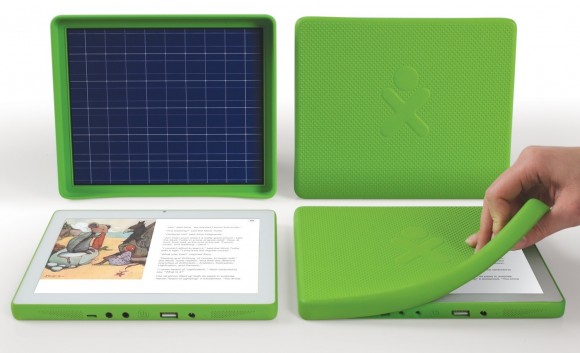
Up front is an 8-inch screen – a 1024 x 768 Pixel Qi panel, no less, for indoor and outdoor visibility – with a peel-off silicone cover so as to protect it from scratches and bumps while in a schoolbag. There’ll also be solar panels on the inside, one of a trio of recharging options to keep the OLPC XO-3 running: as well as plugging it into the mains, should you have the luxury of being near an AC supply, there’ll be a hand-crank to manually top up the battery.
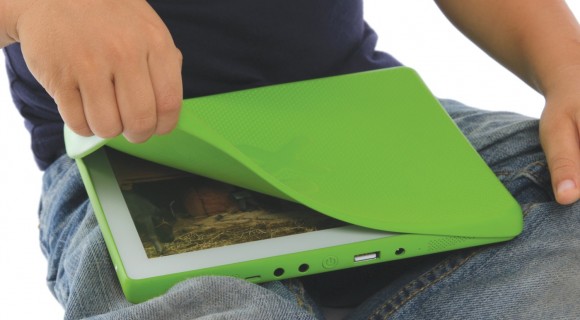
Sixty seconds of cranking is good for ten minutes of use, or so OLPC tells us, and the OS is either Android or the specialist education-focused Sugar platform. Ports – which are also covered up by that clever cover – include full-sized USB, audio and a memory card slot.
Best of all, though, is the price: OLPC expects the XO-3 to kick off at $100, though that will be for regular LCD rather than Pixel Qi versions. Unfortunately, you won’t be able to drop by Best Buy and pick one up, as OLPC will be selling direct to educational organizations and charities.
Quicksearch
Popular Entries
- The great Ars Android interface shootout (131720)
- Norton cyber crime study offers striking revenue loss statistics (102835)
- MeCam $49 flying camera concept follows you around, streams video to your phone (100748)
- Norton cyber crime study offers striking revenue loss statistics (59064)
- The PC inside your phone: A guide to the system-on-a-chip (58964)


