Friday, April 19. 2013
A new way to report data center's Power and Water Usage Effectiveness (PUE and WUE)
-----
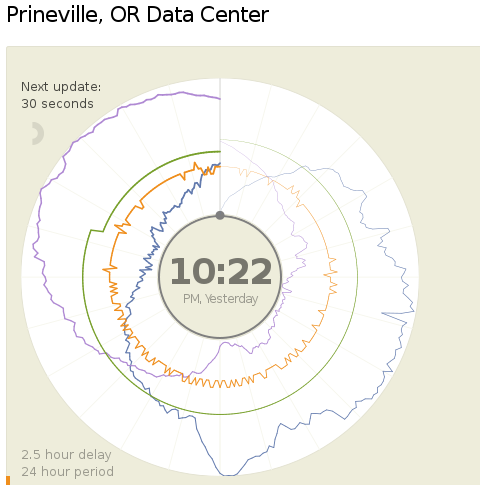
Today (18.04.2013) Facebook launched two public dashboards that report continuous, near-real-time data for key efficiency metrics – specifically, PUE and WUE – for our data centers in Prineville, OR and Forest City, NC. These dashboards include both a granular look at the past 24 hours of data and a historical view of the past year’s values. In the historical view, trends within each data set and correlations between different metrics become visible. Once our data center in Luleå, Sweden, comes online, we’ll begin publishing for that site as well.
We began sharing PUE for our Prineville data center at the end of Q2 2011 and released our first Prineville WUE in the summer of 2012. Now we’re pulling back the curtain to share some of the same information that our data center technicians view every day. We’ll continue updating our annualized averages as we have in the past, and you’ll be able to find them on the Prineville and Forest City dashboards, right below the real-time data.
Why are we doing this? Well, we’re proud of our data center efficiency, and we think it’s important to demystify data centers and share more about what our operations really look like. Through the Open Compute Project (OCP), we’ve shared the building and hardware designs for our data centers. These dashboards are the natural next step, since they answer the question, “What really happens when those servers are installed and the power’s turned on?”
Creating these dashboards wasn’t a straightforward task. Our data centers aren’t completed yet; we’re still in the process of building out suites and finalizing the parameters for our building managements systems. All our data centers are literally still construction sites, with new data halls coming online at different points throughout the year. Since we’ve created dashboards that visualize an environment with so many shifting variables, you’ll probably see some weird numbers from time to time. That’s OK. These dashboards are about surfacing raw data – and sometimes, raw data looks messy. But we believe in iteration, in getting projects out the door and improving them over time. So we welcome you behind the curtain, wonky numbers and all. As our data centers near completion and our load evens out, we expect these inevitable fluctuations to correspondingly decrease.
We’re excited about sharing this data, and we encourage others to do the same. Working together with AREA 17, the company that designed these visualizations, we’ve decided to open-source the front-end code for these dashboards so that any organization interested in sharing PUE, WUE, temperature, and humidity at its data center sites can use these dashboards to get started. Sometime in the coming weeks we’ll publish the code on the Open Compute Project’s GitHub repository. All you have to do is connect your own CSV files to get started. And in the spirit of all other technologies shared via OCP, we encourage you to poke through the code and make updates to it. Do you have an idea to make these visuals even more compelling? Great! We encourage you to treat this as a starting point and use these dashboards to make everyone’s ability to share this data even more interesting and robust.
Lyrica McTiernan is a program manager for Facebook’s sustainability team.
Wednesday, April 17. 2013
Google Mirror API now available

Tuesday, April 16. 2013
Oculus Rift finally gets the reaction virtual reality always wanted
Via Slash Gear
-----
We’ve already heard plenty about the Oculus Rift virtual reality headset, and while we youngsters are pretty amazed by the technology, nobody has their mind blown more than the elderly, who could only dream about such technology back in their younger days. Recently, a 90-year-old grandmother ended up trying out the Oculus Rift for herself, and she was quite amazed.
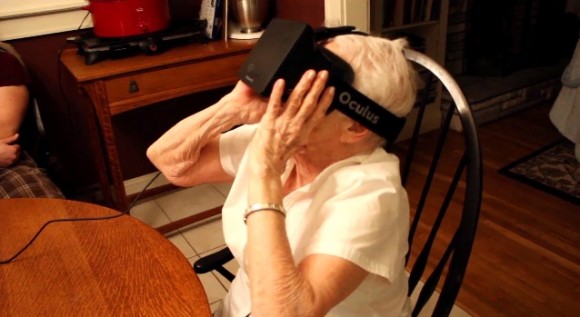
Imagimind Studio developer Paul Rivot ended up grabbing an Oculus Rift in order to play around with it and develop some games, but he took a break from that and decided to give his grandmother a little treat, by strapping the Oculus Rift to her head in order to experience a bit of virtual reality herself.
The video is quite entertaining to watch, and we can’t imagine what’s going on inside of her head, knowing that she never grew up with such technology as the Oculus Rift, let alone 3D video games. She even gets to the point where she thought the images being displayed were actual images taken on-location, when in fact it’s all 3D-rendered on a computer.
Currently, the Oculus Rift is out in the wild for developers only at this point, and there’s no announced release date for the device, although the company has noted that it should arrive to the general public before the 2014 holiday season. In the meantime, it’s videos like this that only excite us even more.
Thursday, April 11. 2013
Researchers Replace Passwords With Mind-Reading Passthoughts
Friday, April 05. 2013
Computers Made Out of DNA, Slime and Other Strange Stuff
Via Wired
-----

Everybody knows a computer is a machine made of metal and plastic, with microchip cores turning streams of electrons into digital reality.
A century from now, though, computers could look quite different. They might be made from neurons and chemical baths, from bacterial colonies and pure light, unrecognizable to our old-fashioned 21st century eyes.
Far-fetched? A little bit. But a computer is just a tool for manipulating information. That's not a task wedded to some particular material form. After all, the first computers were people, and many people alive today knew a time when fingernail-sized transistors, each representing a single bit of information, were a great improvement on unreliable vacuum tubes.
On the following pages, Wired takes a look at some very non-traditional computers.
Above:Slime Computation
"The great appeal of non-traditional computing is that I can connect the un-connectable and link the un-linkable," said Andy Adamatzky, director of the Unconventional Computing Center at the University of the West of England. He's made computers from electrified liquid crystals, chemical goo and colliding particles, but is best known for his work with Physarum, the lowly slime mold.
Amoeba-like creatures that live in decaying logs and leaves, slime molds are, at different points in their lives, single-celled organisms or part of slug-like protoplasmic blobs made from the fusion of millions of individual cells. The latter form is assumed when slime molds search for food. In the process they perform surprisingly complicated feats of navigation and geometric problem-solving.
Slime molds are especially adept at finding solutions to tricky network problems, such as finding efficient designs for Spain's motorways and the Tokyo rail system. Adamatzky and colleagues plan to take this one step further: Their Physarum chip will be "a distributed biomorphic computing device built and operated by slime mold," they wrote in the project description.
"A living network of protoplasmic tubes acts as an active non-linear transducer of information, while templates of tubes coated with conductor act as fast information channels," describe the researchers. "Combined with conventional electronic components in a hybrid chip, Physarum networks will radically improve the performance of digital and analog circuits."
Image: Adamatzky et al./International Journal of General Systems
The Power of the Blob
Inspired by slime mold's problem-solving abilities, Adamatzky and Jeff Jones, also of the University of the West of England, programmed the rules for its behavior into a computational model of chemical attraction. That Russian nesting doll of emulations -- slime mold interpreted as a program embodied in chemistry translated into a program -- produced a series of experiments described in one superbly named paper: "Computation of the Travelling Salesman Problem by a Shrinking Blob."
In that paper, released March 25 on arXiv, Jones and Adamatzky's simulated chemical goo solves a classic, deceptively challenging mathematical problem, finding the shortest route between many points. For a few points this is simple, but many points become intractably difficult to compute -- but not for the blob (above).
Video: Jeff Jones and Andrew Adamatzky
Crystal Calculations
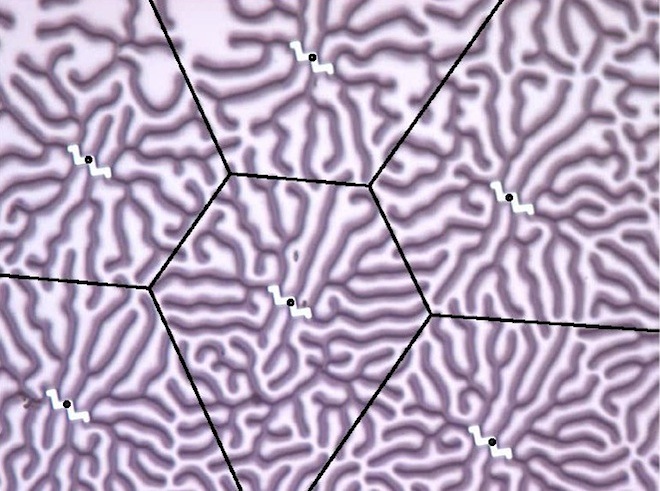
For decades, scientists who study strange materials known as complex fluids, which switch easily between different phases of matter, have been fascinated by the extraordinary geometries formed by liquid crystals at different temperatures and pressures.
Those geometries are stored information, and the interaction of crystals a form of computation. By running an electric current through a thin film (above) of liquid crystals, researchers led by Adamatzky were able to perform basic computational math and logic.
Image: Adamatzky et al./arXiv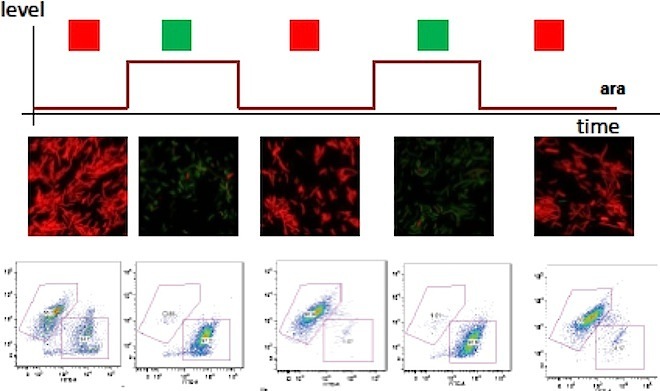
Computational DNA
It's hard to keep up with the accomplishments of synthetic biologists, who every week seem to announce some new method of turning life's building blocks into pieces for cellular computers. Yet even in this crowded field, last week's announcement by Stanford University researchers of a protein-based transistor stood out.
Responsible for conducting logic operations, the transistor, dubbed a "transcriptor," is the last of three components -- the others, already developed, are rewritable memory and information transmission -- necessary to program cells as computers. Synthetic biologist Drew Endy, the latest study's lead author, envisions plant-based environmental monitors, programmed tissues and even medical devices that "make Fantastic Voyage come true," he said.
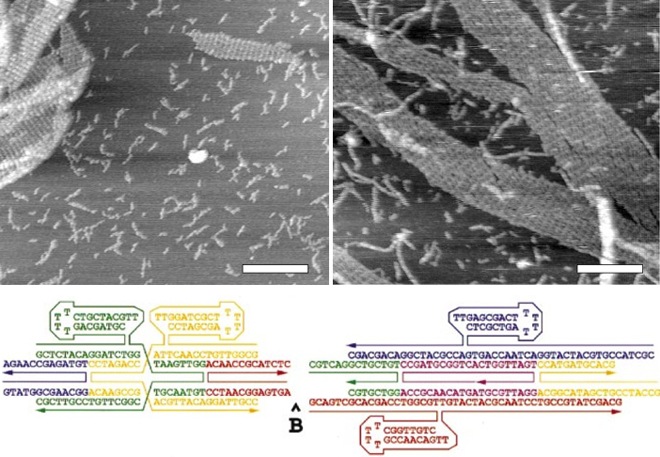
In the image above, Endy's cellular "buffer gates" flash red or yellow according to their informational state. In the image below, a string of DNA programmed by synthetic biologist Eric Winfree of the California Institute of Technology runs synthetic code -- the A's, C's, T's and G's -- with its molecules.
Evolution's Design
Most designs for molecular computers are based on human notions of what a computer should be. Yet as researchers applied mathematician Hajo Broersma of the Netherlands' University of Twente wrote of their work, "the simplest living systems have a complexity and sophistication that dwarfs manmade technology" -- and they weren't even designed to be that way. Evolution generated them.
In the NASCENCE project, short for "NAnoSCale Engineering for Novel Computation using Evolution," Broersma and colleagues plant to exploit evolution's ability to use combinations of molecules and their emergent properties in unexpected, incredibly powerful ways. They hope to develop a system that interfaces a digital computer with nano-scale particle networks, then use the computer to set algorithmic goals towards which evolution will guide the particles.
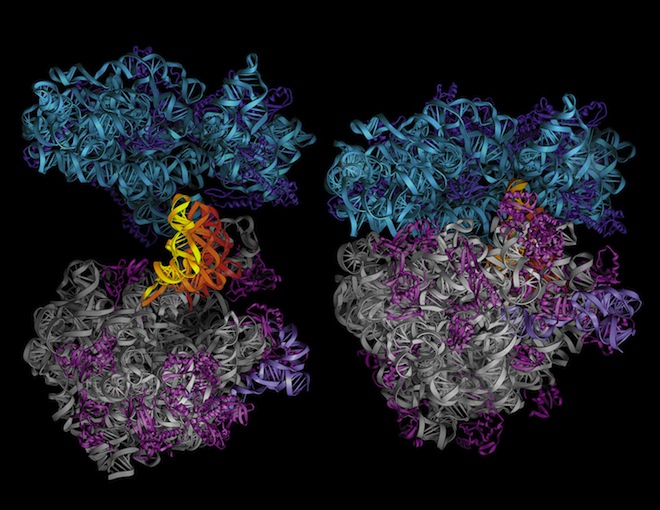
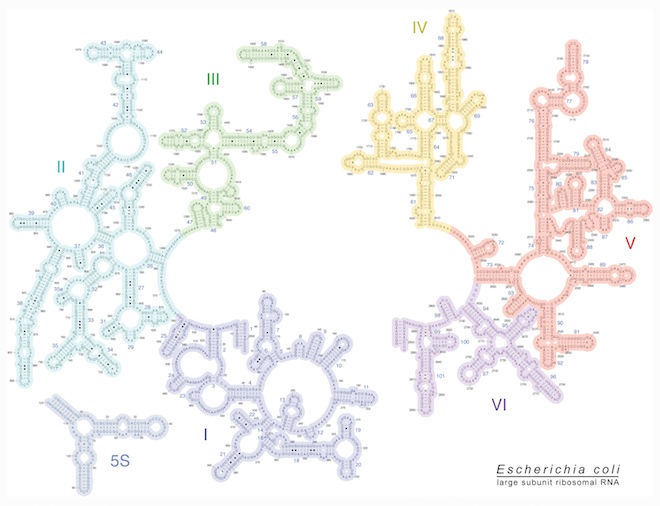
"We want to develop alternative approaches for situations or problems that are challenging or impossible to solve with conventional methods and models of computation," they write. One imagines computer chips with geometries typically seen in molecular structures, such as the E. coli ribosome and RNA seen here; success, predict Broersma's team, could lay "the foundations of the next industrial revolution."
Images: Center for Molecular Biology of RNA/University of California, Santa Cruz
Particle Collisions
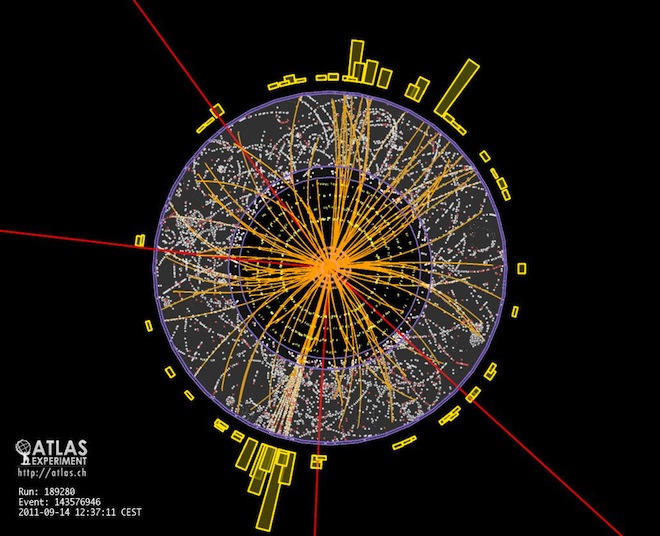
The Large Hadron Collider's 17 miles of track make it the world's largest particle accelerator. Could it also become the world's largest computer?
Not anytime soon, but it's at least possible to wonder. Another of Adamatzky's pursuits is what he calls "collision-based computing," in which computationally modeled particles course through a digital cyclotron, with their interactions used to carry out calculations. "Data and results are like balls travelling in an empty space," he said.
In the image below, simulated particle collisions evolve over time. Above, protons collide during the Large Hadron Collider's ATLAS experiment.

Images: 1) CERN 2) Martinez et al./A Computable Universe
Quantum Computers
The idea of computers that harness the spooky powers of quantum physics -- such as entanglement, in which far-flung particles are linked across space and time, so that altering one instantaneously affects the other -- has been around for years. And though quantum computers are still decades from reality, achievements keep piling up: entanglement made visible to the naked eye, performed with ever-greater numbers of particles, and used to control mechanical objects.
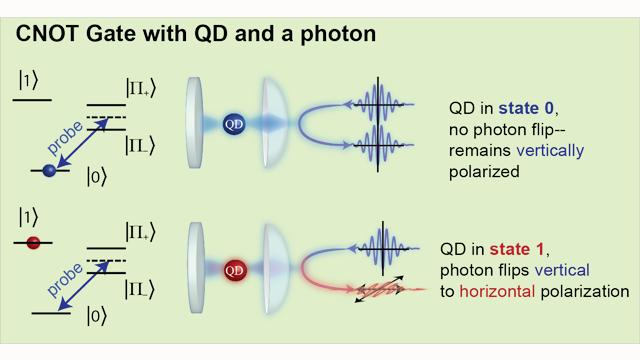
The latest achievement, described March 31 in Nature Photonics by physicist Edo Waks of the University of Maryland and colleagues, involves the control of photons with logic gates made with quantum dots, or crystal semiconductors controlled by lasers and magnetism. The results "represent an important step towards solid-state quantum networks," the researchers wrote.
Image: Schematic of the quantum dot-controlled photon. (Kim et al./Nature Photonics)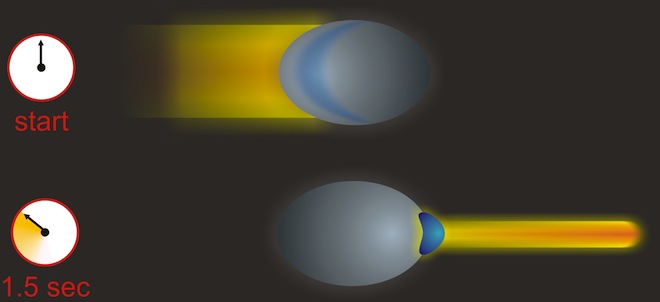
Frozen Light
If quantum computers running on entangled photons are still far-off, there's another, non-quantum possibility for light-based computing. Clouds of ultra-cold atoms, frozen to temperatures just above absolute zero -- the point at which all motion ceases -- might be used to slow and control light, harnessing it inside an optical computer chip.
Image: Schematic of controlled light. (Anne Goodsell/Harvard University)
The Quantum Brain
It's easy to think of minds as computers, and accurate in the sense that brains are information-processing systems. They are also, however, exponentially more complex and sophisticated than any engineered device.
Even as quantum computing remains a far-off dream, some scientists think quantum physics underlies our thoughts. The question is far from settled, but quantum processes have been observed in a variety of non-human cells, raising the alluring possibility of a role in thought.
"Quantum computation occurs in the human mind, but only at the unconscious level," said theoretical physicist Paola Zizzi of Italy's University of Padua. "As quantum computation is much faster than classical computation, the unconscious thought is then much faster than the conscious thought and in a sense, it 'prepares' the latter."
If identified in our brains, quantum thinking could be used to inspire computer designs not yet dreamed of. Broadly speaking, that's a motivation of many in the non-conventional computing community, said Hector Zenil, a computer scientist at Sweden's Karolinska University and editor of A Computable Universe: Understanding and Exploring Nature as Computation.
Zenil isn't convinced by quantum claims for the brain, but he sees a world suffused by informational processes. Researchers like himself and Zizzi are trying to "use the computational principles that nature may use in order to conceive new kinds of computing," said Zenil.
Image: Sea slug neuron. (Dylan Burnette/Olympus Bioscapes)

Universe As Computer
In A Computable Universe, Zenil and others take the idea of computation as an abstract process, capable of being performed on any system that can store and manipulate information, to its logical extreme. Computers might not only be made from chemicals and cells and light, they say; the universe itself could be a computer, processing the information of which our everyday experiences -- and everything else -- are composed.
This is a tricky idea -- if the universe is computed, what's the computer? -- and for obvious reasons difficult to test, though Zenil thinks it's possible. In his work on the algorithmic aspects of existence, he's developed measures of the statistical distributions one would expect to see if reality is in fact computed.
If that seems a scary proposition, in which life would play out in linear mechanical ordination, rest assured: mechanistic, predetermined processes don't hold sway in a universal computer. Some aspects of existence will necessarily be "undecidable," impossible to describe with algorithms or predict beforehand. Ghosts will still live in the machine.
Image: The Milky Way galaxy/NASA/ESA/Q.D. Wang/Jet Propulsion Laboratory/S. Stolovy
Wednesday, April 03. 2013
The smell-o-vision TV implements scents with your favorite TV programs
Via Slashgear
-----
A tech team from Tokyo University of Agriculture and Technology in Japan have unveiled a smell-o-vision TV that will bring a sense of reality from our favorite TV programs. The team created a “smelling screen” that enables scents in spots where the corresponding object is placed. The screen generates scents from gel pellets from four air streams on all corners of the display. The scents are blown at varying and controlled rates to make it seem as though the scent is coming directly from the object on-screen.
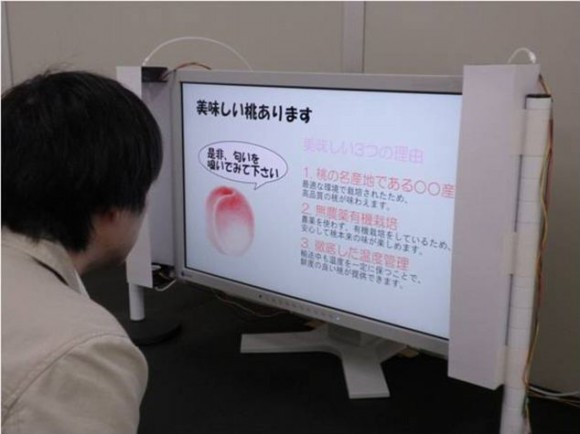
This isn’t the first time the “smell-o-vision” technology has appeared in the tech world, however it is the first time that is has been implemented into television screens. The smell-o-vision technology was first implemented in a 1960?s film titled “Scent of Mystery”. The film launched in 3 customized movie theaters in New York City, Los Angeles, and Chicago. In the film, there were scents dispersed to the audience during certain moments in the film. Unfortunately, the film was a huge failure due to the malfunctioning of the scent mechanism. There were delayed actions between the specific scenery and the scents, and the mechanisms made a loud noise while releasing the scents.
This Japanese team seems to have been able to address the problem however, and successfully implemented the smell-o-vision technology in televisions. Right now, there can only be one scent released at a time, however, the team hopes to be able to make it so multiple smells could be implemented at the same time. They’re hoping to do so by implementing a cartridge-like system that will allow them to alternate smells more easily.
While the smell-o-vision can make movies and TV shows more engaging and real, it also has somewhat of a negative effect. Advertisement agencies can take advantage of the technology as well, and when they do, all hell will break loose. If you thought that steak in that commercial looked good now, wait until you can actually smell it. With this new technology, restaurants will be able to more effectively rake in customers with their advertisements. We’ll keep you posted as soon as more information regarding the smell-o-vision is unveiled.
Quicksearch
Popular Entries
- The great Ars Android interface shootout (131713)
- Norton cyber crime study offers striking revenue loss statistics (102811)
- MeCam $49 flying camera concept follows you around, streams video to your phone (100738)
- Norton cyber crime study offers striking revenue loss statistics (59040)
- The PC inside your phone: A guide to the system-on-a-chip (58949)


